Every technical founder asks the same question, and almost all of them ask it the same wrong way: “How do I get my first 100 customers?” Then they reach for the same answer — post more on LinkedIn, launch on Product Hunt, write a few blog posts, maybe try Reddit, maybe try ads — and stall.
The reason isn't effort. It's framing. First 100 customers isn't a content problem. It's a distribution problem.Content is what runs through a distribution mechanism. If you don't have the mechanism, no amount of content fixes anything — you're just adding water to a leaky bucket.
Below is what builders who actually hit their first 100 (and then 1,000, and then 100,000) did differently — drawn from four companies we've teared down in detail, and what you can copy from each.
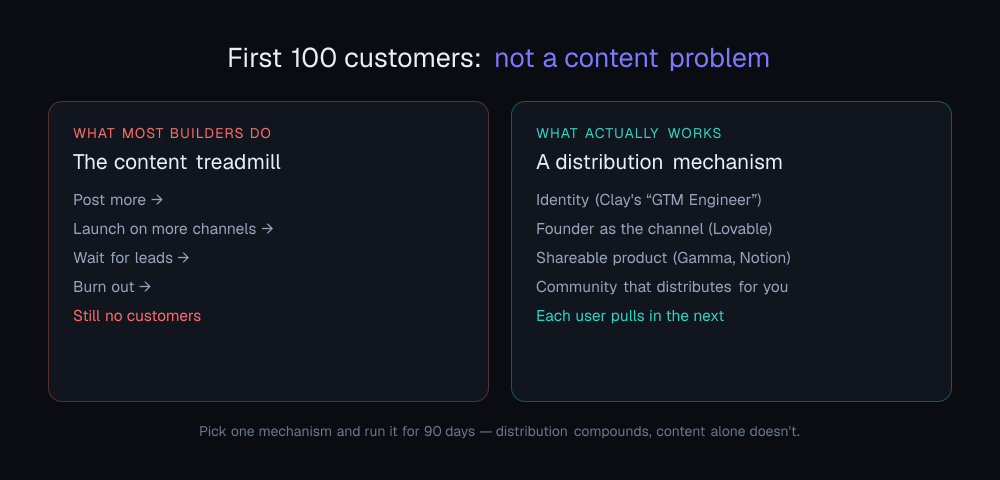
The pattern: every “overnight” B2B/AI startup engineered distribution
Clay went from $1M to $100M ARR in two years with zero paid ads. Lovable hit $400M ARR in 14 months with 146 people and no sales team. Notion crossed 30M users without a traditional outbound motion. Gamma reached $100M ARR with 52 employees and $0 in ads.
These aren't outliers because their products are special — there are dozens of great products nobody finds. They're outliers because they each designed a distribution mechanism upstream, then let it carry users to them. Once you see the mechanism, the “how do I get my first 100” question changes shape.
Four mechanisms that actually work for builders
1. Make your users do the distributing (identity + community)
Clay didn't hire a content agency or run ads. They invented a profession — “GTM Engineer” — and built a Slack community around it that grew from 200 to 11,000+ members. Every user who started calling themselves a GTM Engineer was implicitly endorsing Clay. The community published workflows, ran events, and brought Clay into new jobs when members switched companies. (Source: First Round Review; nrich.io)
Whether you can pull off “invent a profession” depends on the product. But the underlying principle transfers to every builder: name the thing your users do, give them tools and recognition for doing it together, and they will distribute for you. The first 100 doesn't come from your effort — it comes from a small early community whose effort compounds.
→ Full teardown: How Clay Hit $100M ARR With No Ads
2. Make the founder the distribution channel
Anton Osika, Lovable's founder, didn't hire a head of marketing until after $10M ARR. Until then, he was the channel — 2–3 LinkedIn posts a week to a 97K-follower audience, with one principle: “transparency over perfection.”He shared real numbers, real decisions, the messy middle. That credibility converts at rates paid acquisition can't touch.
Kareem Amin at Clay ran a similar playbook: operating principles, customer impact stories, milestone-with-thinking posts, product strategy with proof. He never posted as a CEO selling a product — he posted as a practitioner thinking out loud. (Source: First Round Review)
For builders this is the lowest-cost mechanism: you, in public, on one channel, for 90 days without quitting.Most founders quit at week 4. The ones who don't compound an audience nothing else can match. The first 100 customers often come from your own audience, not from strangers.
→ Full teardown: How Lovable Hit $400M ARR With No Sales Team
3. Build distribution into the product (shareable output)
Gamma ships every free-tier presentation with a “Made with Gamma” badge. At 250M+ presentations, that's 250M passive ads — and the badge doubles as an upgrade trigger. It's the same mechanism that built Hotmail. Lovable did a similar thing with Linkable: every site it generated shipped with an “Edit with Lovable” button; one founder tweet produced 20,000 sites in a week, each one a backlink and a discovery surface.
Notion went further: 10,000+ community-made templatesare not a feature — they're a distribution channel with a product attached. Every template is a free, specific, socially-proofed demo that pulls in the next user. (Source: Notion; Sacra)
For builders: what does your product produce, and how can each output carry a link back to you?If users can't easily show others what they made with you, you're leaving the most efficient distribution channel on the table. Visual products have it easiest, but every product has some shareable artifact — dashboards, reports, templates, before/after comparisons.
→ Full teardowns: Gamma · Notion
4. Embed in places your buyers already are (don't build your own crowd from zero)
Clay's first community move wasn't to start their own Slack — it was to embed in existing ones (Modern Sales Pros, SaaS Yacht Club, Sales Technicians) and answer real questions for months before pitching anything. They used keyword alerts to catch any mention of outbound automation or data enrichment, then responded with genuine help. The trust this builds cannot be bought.
For builders, the equivalent is showing up real in 2–3 communities where your buyers already hang out — Reddit subreddits, niche Discord/Slack groups, dedicated forums — for 90 days before you mention your product. Spraying links gets you banned in an hour; being the most helpful person in the room gets you customers without ever pitching.
What this means for your first 100 (the 30/60/90 plan)
Pick oneof the four mechanisms above — the one your product most naturally suits — and run it on this timeline. Don't mix four; you'll do all of them badly.
- Days 0–30 — Wire the mechanism. If founder-as-channel: start posting 2–3× a week, sharing real decisions and lessons (not features). If product-shareability: add the link-back to whatever your product produces. If community: pick 2–3 places your buyers already are and start showing up real. If identity: name the role your users play and start using that language everywhere.
- Days 30–60 — Show up consistently while the data is still ugly. Most builders quit here. You won't see the compounding yet. The first real traction is usually around week 6–8 — strangers find you, not friends.
- Days 60–90 — Listen for what's working and double down. One post format, one channel, one community usually pulls 80% of the traction. Drop the rest. Run the winner harder. By day 90, expect your first 3–20 paying customers and a clear signal on which channel is actually yours.
What NOT to do (the predictable wrong moves)
- Don't hire a content agency at this stage. They can't fake founder credibility. Lovable's first marketing hire came after $10M ARR. Anton was the voice until then.
- Don't run ads to your homepage. Without product-market fit and a distribution mechanism, ads are just expensive learning. Save the money.
- Don't spread across 5 channels. Pick one, run it for 90 days, then evaluate. Multi-channel theater with no traction is the most expensive form of doing nothing.
- Don't mistake a Product Hunt launch for a distribution system. Launches are events; distribution is a system that keeps running after the event. The companies above all launched, but they were each running a mechanism long before launch day.
The honest expectation
The companies above look like overnight successes only because of where they ended up. Clay spent six yearsat near-zero revenue waiting for the market. Notion almost died in 2015 and rebuilt from scratch. Lovable's open-source repo had 52K stars before there was a business model. The mechanism was running for years before it “worked.” You probably don't have six years, which means execution has to be sharper — but the principle is identical: distribution as a system, run for long enough to compound.
First 100 customers is not a content problem. It's the question every builder asks, and the answer almost no one teaches: build a distribution mechanism, run it long enough that users start bringing other users, and your “first 100” turns into “the first 1,000.”
Sources: First Round Review (Clay); nrich.io (Clay); TechCrunch (Lovable); Lenny's Newsletter (Lovable); Notion; Sacra (Notion); Sequoia “Training Data” podcast (Gamma); TechCrunch (Gamma). External figures are reported from those sources and not independently verified by Runnax.