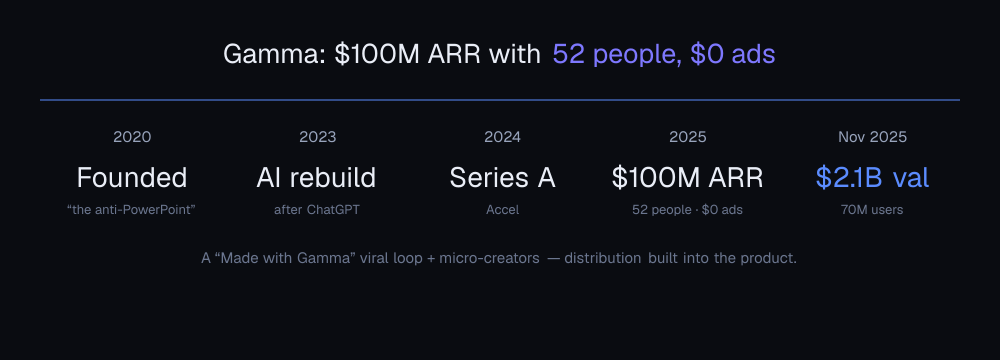
When Gamma's founders pitched the idea, one investor told them it was “the worst pitch, worst idea I have ever heard.”Gamma went on to $100M ARR with 52 employees and a $2.1B valuation (announced November 2025), 70 million users, and two-plus years of consecutive profitability — on zero paid advertising. That's $1.9M ARR per employee.
The reflex is to credit the product. But Gamma's edge wasn't a better slide tool — it was distribution engineered into the product itself. Three compounding mechanisms did the work a sales-and-marketing org normally does.
What Gamma is: the anti-PowerPoint
Founded in 2020 by Grant Lee, Jon Noronha, and James Fox, Gamma is an AI tool that generates presentations, sites, and documents — positioned as “the anti-PowerPoint.” It solves the blank-page problem: instead of dropping you into an empty canvas, it gets you to a finished draft fast.
The AI-native rebuild that changed everything
Gamma launched, then stalled. After ChatGPT landed at the end of 2022, the team rebuilt the product AI-native in 2023 — choosing a prompt-engineering and model-orchestration approach (routing tasks to different models) over fine-tuning. That reset the trajectory and set up the Series A from Accel in 2024.
The “first 30 seconds” obsession
When growth stalled, Gamma didn't pour money into ads — it fixed onboarding. The goal: get a new user playing with real output within the first 30 seconds. This is a distribution decision disguised as a UX one. The magic moment is what gives each user something worth filming and sharing — without it, none of the viral mechanics have fuel. Fix the first experience before you fix distribution.
The micro-creator network, not macro influencers
Gamma built a distribution channel out of 1,000+ micro-creators (roughly 5,000–50,000 subscribers each) making tutorial-first content — “here's how I made a sales deck in minutes” — instead of paying macro-influencers for hype. It went wide, let the data surface the ~10% of creators driving ~90% of the results, then invested in those relationships. Paid ads run $15–$50 CPCs and an in-house content team is 5–10 people; Gamma got compounding, trusted reach instead.
Built-in viral distribution: the “Made with Gamma” loop
Every presentation on the free tier ships with a “Made with Gamma”badge. With 250M+ presentations created, that's 250M passive ads — and the badge doubles as an upgrade trigger. As Gamma puts it, “it's the same mechanism that made Hotmail grow in the late 90s.”The product's own output recruits the next user. You don't buy that distribution; you design it in.
The India surprise: 9.5M users, $0 spent
India became Gamma's fastest-growing market — 9.5 million users — with zero local marketing spend. Co-founder Grant Lee's read: “that tells us how AI-native the market already is.” When distribution is built into the product, it travels to places a paid-acquisition plan would never target.
Hire painfully slow
Gamma resisted the post-raise urge to triple headcount. Grant Lee's rule: “hire painfully slow.”The result is 0% employee turnover since founding — all ten original employees still on board — and a no-996 culture. The lean org isn't a constraint working around weak distribution; it's the proof that distribution was solved in the product, so it didn't need an army to push.
The numbers
- $100M ARR with 52 employees → $1.9M ARR per employee
- $2.1B valuation (November 2025); 70 million users
- 250M+ presentations created; 1,000+ micro-creators in the program
- India: 9.5M users on $0 local marketing spend
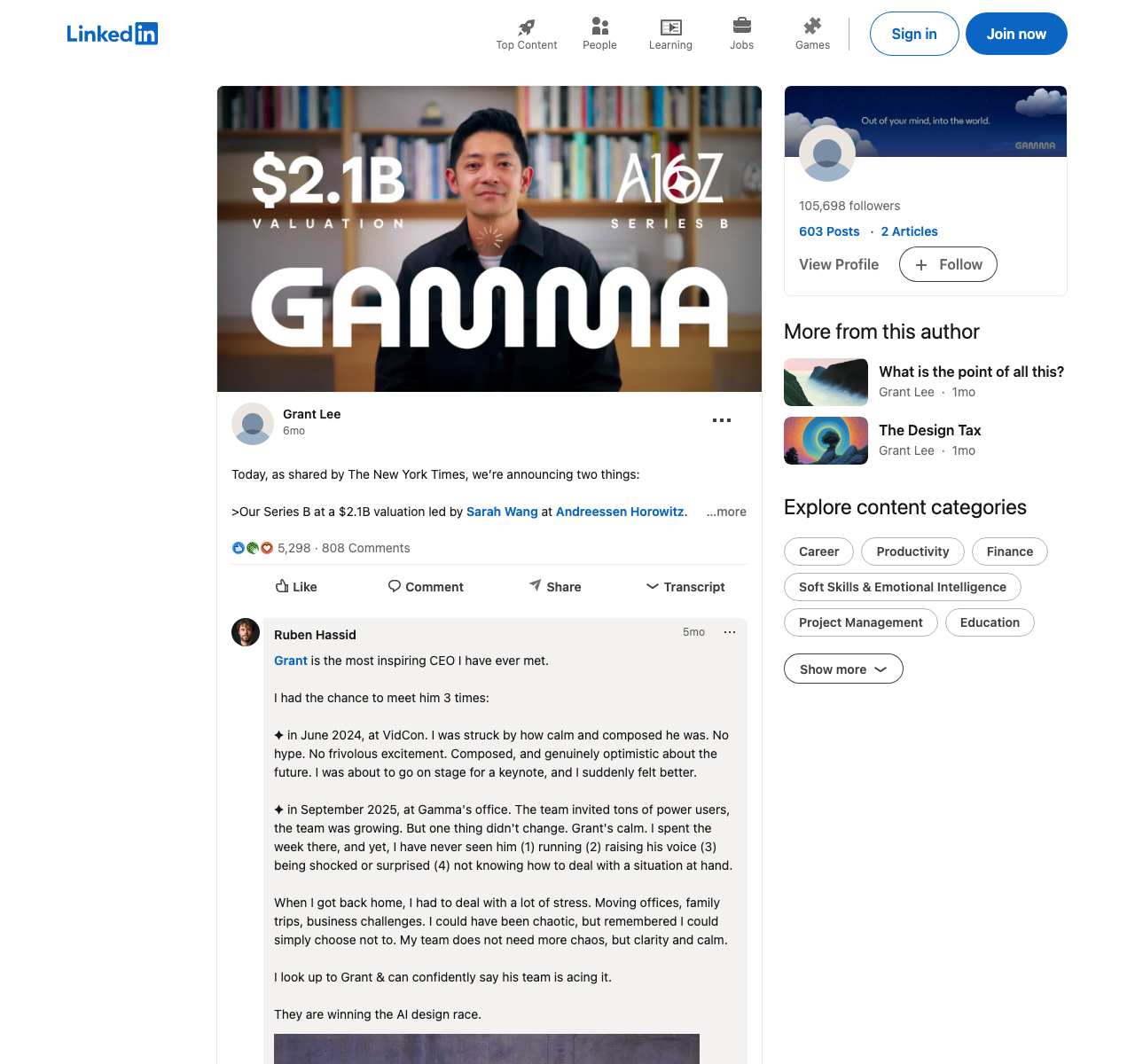
- Funding: $7M seed → $12M Series A (Accel, 2024) → $68M Series B (+ $20M secondary)
- Free plan: 400 AI credits to start; Plus $8/month; Pro $18/month
The Runnax read
Gamma is the same lesson as every teardown here: most builders don't have a product problem — they have a distribution problem.Gamma stalled with a fine product and took off only once distribution was engineered into it — a viral loop, a creator network, a 30-second magic moment. Knowing that is easy; building and running the system while you ship the product is the hard part. That's the gap Runnax closes: it diagnoses why customers aren't finding you, finds what works in your space (with real examples like this one), builds the deterministic distribution system, and runs it.
Sources: TechCrunch; Economic Times; Sequoia “Training Data” podcast; Accel; The New York Times; The Split podcast. External figures are reported from those sources and not independently verified by Runnax.