I've worked with hundreds of founders on getting found. The ones who fail fastest all start the same way — hire an agency, run some ads, wait for leads. Clay did the opposite. They went from $1M to $100M ARR in two years, with no paid ads, no content agency, and no traditional demand gen.
If you're an AI or SaaS builder who can ship but can't get customers — who's tried agencies, burned budget on channels that didn't work, or simply can't find time to be visible — read this as what it actually is: not a content story, a distribution story. Clay's product was good. So is yours. The thing they engineered was the part no one teaches builders: a system that gets the product in front of the right people, repeatably, without the founder grinding it out by hand.
What Clay does
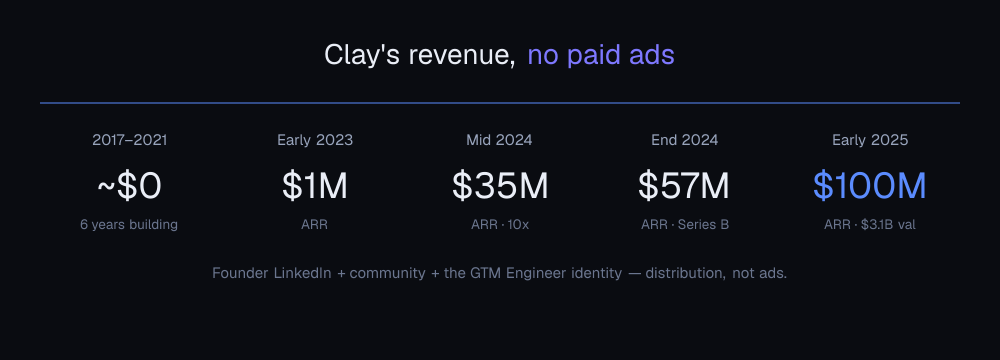
Clay is a B2B data enrichment and outbound automation platform, founded in 2017 by Kareem Amin and Nicolae Rusan. The company spent six years quietly building with near-zero revenue. By early 2023 it hit $1M ARR. By early 2025: $100M ARR, a $3.1B valuation, and over 100K users.
The thing that changed wasn't a new feature or a funding round. It was a distribution strategy — one most marketing teams would never even consider running.
The mechanism: create a job title, not a campaign
Clay didn't run ads. They didn't hire a content agency. They invented a profession. The term “GTM Engineer” didn't exist before Clay. They coined it to describe a new kind of practitioner — someone who builds automated data pipelines, enrichment workflows, and outreach sequences for go-to-market teams.
“Your GTM motion isn't under-staffed — it's under-engineered.” — Clay's manifesto
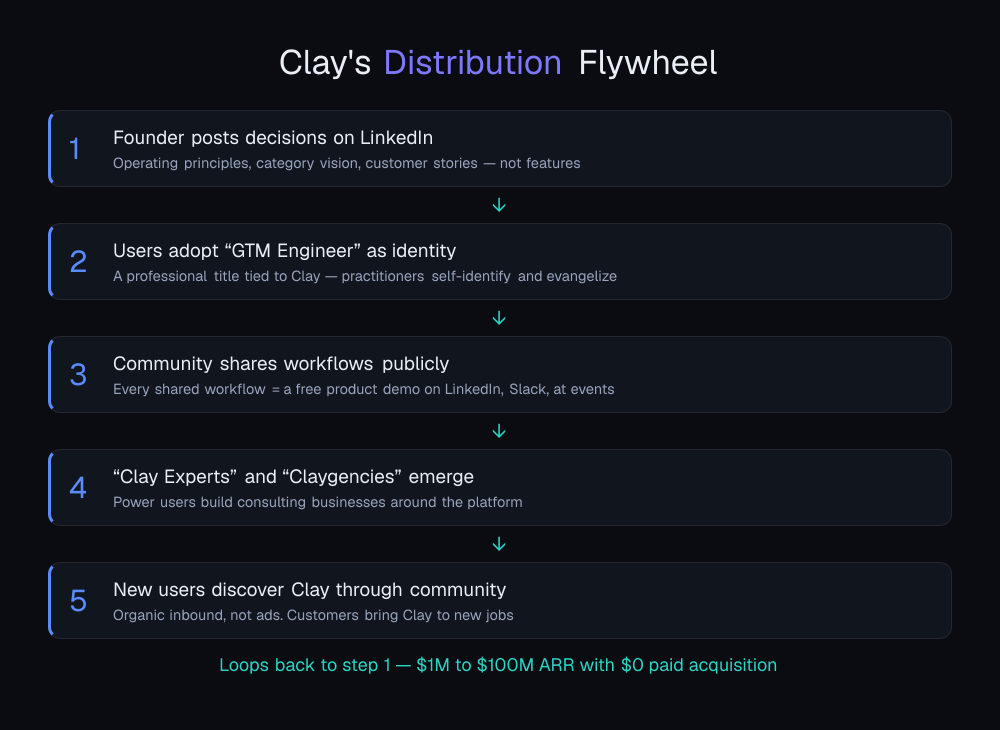
By naming the role and building a community around it, Clay turned their users into their distribution channel. Every GTM Engineer who shared a Clay workflow on LinkedIn was doing free product marketing. Every case study a practitioner published was organic demand gen Clay didn't pay a dollar for. The scale is worth pausing on:
- 100+ GTM Engineer job listings appear on LinkedIn every month
- 40+ independent “Clay Experts” have built consulting careers around the platform
- 60+ Clay Clubs host events globally
- “Claygencies” — agencies specializing in Clay implementations — became an entire business category
- Someone is now pursuing a PhD in GTM Engineering
(Source: nrich.io)
This is the single most effective distribution play I've ever studied. Most companies create content that talks about their product. Clay created an identity that made people want to talk about their product for them.
What the founder actually did: Kareem Amin's LinkedIn playbook
Kareem's LinkedIn presence was the anchor of the whole machine. But he wasn't posting “5 tips for better outbound.” He ran a specific, repeatable playbook with four post types:
1. Operating principles
He shared how Clay makes internal decisions. One post on “non-attached action” explained their sprint discipline: “Once we agree to something and it's in our sprint planning, nothing will shift it.” Posts like this filter the audience — casual readers scroll past, operators who think the same way (exactly Clay's buyer) stop and engage. That's the point.
2. Customer impact stories
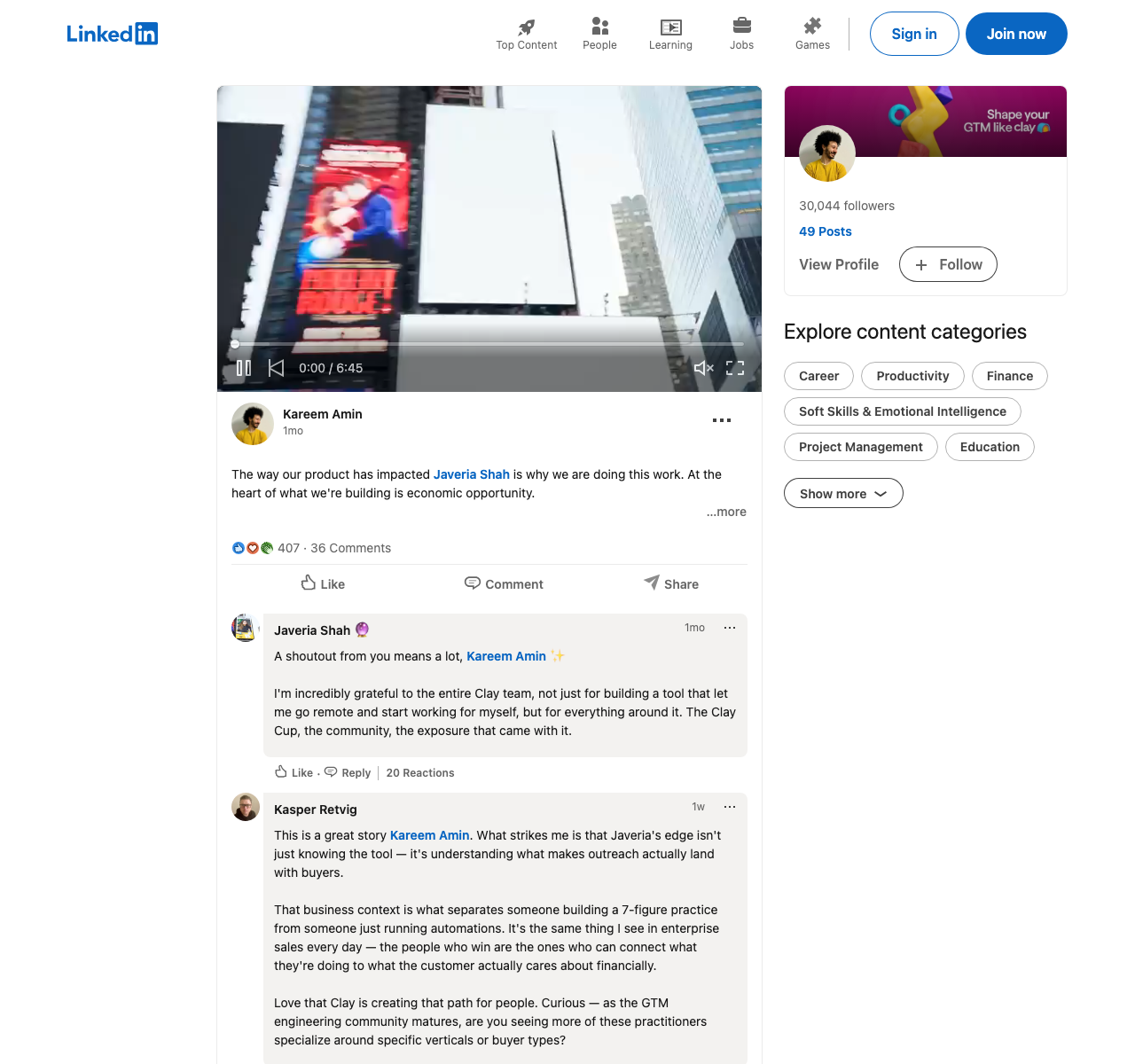
Not generic testimonials — specific journeys. Javeria Shah won the first Clay Cup from Karachi, turned down a $150K job offer at 26, and built a seven-figure GTM Engineering business with her husband, all on skills she developed with Clay. Stories like that make the identity aspirational.
3. Milestone posts with product thinking
When Clay raised $62M or announced a $1.25B valuation, Kareem explained the why — the product vision, the bet on a market shift. Every milestone doubled as category education.
4. Product strategy with proof
He shared real numbers: Clay's growth team used their own product to drop LinkedIn CPL from $250 to $25 via auto-synced exclusion lists. Not a case-study PDF — a post showing results from their own usage.
The pattern: Kareem never posted as “Clay CEO selling a product.” He posted as a practitioner thinking out loud about how go-to-market is changing. That framing made every post feel like insight, not promotion. (Source: First Round Review)
I see the opposite mistake constantly: founders default to talking about features. The ones who get found talk about decisions— why they built what they built, what they chose not to, what surprised them. That's what people follow.
The community flywheel: 200 → 11,000 members
Clay's community followed a deliberate four-step playbook, and the order matters.
Step 1 — Infiltrate existing communities first
Before building their own, Clay embedded where their buyers already were: Modern Sales Pros, SaaS Yacht Club, Sales Technicians Slack groups. They used Syften to set keyword alerts — whenever someone mentioned outbound automation or data enrichment, Clay responded immediately with genuine help. Not pitches. Actual help.
Step 2 — Make community a core business function
Clay's third hire was Eric Nowoslawski, a community champion — “the king of the WhatsApp groups.” Not an engineer, not a salesperson. Hire number three tells you how seriously they treated distribution from day one. (Source: First Round Review)
Step 3 — Force community joining
The boldest move: they removed Intercom — their support tool — and mandated that users join the Slack to get help. Most companies would never. But every question became visible, users helped users, and solutions became shared knowledge. The Slack grew from 200 to over 11,000 members.
Step 4 — Let the community become the sales force
- Users shared workflows publicly — every shared workflow was a live demo Clay didn't pay for.
- “Clay Experts” emerged — practitioners who built consulting businesses around the platform.
- Customers brought Clay to new jobs — built-in expansion with zero sales effort.
In September 2024, Clay held Sculpt, their first conference in San Francisco with 300+ GTM operators — generating case studies and community identity no competitor could replicate by outspending them. (Source: nrich.io)
The content cascade: a loop, not a firehose
Clay's team described their process as a loop: “Every conversation turns into product feedback, every conversation turns into content.” In practice:
- LinkedIn posts — test ideas as short-form
- Top performers become blog posts — expanded with data
- Blog posts become guides — like “The Rise of the GTM Engineer”
- Guides generate community discussion — which feeds new post ideas
Clay never guessed what to make. The community told them what resonated, and they expanded it. Test short, expand the winners, loop the learnings back — that's a system, run like engineering, not a content calendar.
The timing factor nobody talks about
Most Clay breakdowns stop at the tactics. They miss why it worked when it worked. Clay spent six years at near-zero revenue — they waited for the market to catch up. Three shifts converged in 2022–2023:
- AI made enrichment accessible. Before the LLM wave, building these workflows took serious technical chops. AI lowered the barrier and expanded Clay's market overnight.
- Remote work made outbound automation essential. It went from “nice to have” to survival tool.
- LinkedIn's algorithm shifted to reward long-form practitioner content over corporate posts — exactly Kareem's style.
Clay's “overnight success” was a six-year bet on timing. The distribution mechanism was the ignition — the fuel was already there. Most builders don't have six years to wait, which means execution has to be faster and more consistent to compensate.
The numbers
| Metric | Before (2022) | After (2025) |
|---|---|---|
| ARR | ~$1M | $100M |
| Slack community | 200 members | 11,000+ |
| “GTM Engineer” job listings | 0 | 100+/month |
| Paid advertising spend | $0 | $0 |
| Independent Clay Experts | 0 | 40+ |
| Valuation | Undisclosed | $3.1B |
Two more tactics most people miss
The 15-month waitlist
While growing through millions in ARR, Clay kept a 15-month waitlist — deliberately limiting access to protect quality and community signal. It created scarcity, but more importantly it meant early users were genuinely invested and became the strongest evangelists. Most early-stage builders can't wait 15 months — but the principle holds: your first 100 users matter more than your first 10,000 impressions.
The reverse demo
Clay threw out scripted demos. Instead, “reverse demos” — 30-minute sessions where the prospect brings their real data problem and Clay solves it live. The prospect left with a workflow they could use that day, and the close rate was dramatically higher.
What made it work (the non-obvious parts)
- They didn't scale content. They scaled identity. When someone calls themselves a “GTM Engineer,” they're implicitly endorsing Clay. The distribution created itself.
- The founder was the category anchor, not the brand. Kareem posted as a practitioner, not a CEO. The moment content feels like a sales pitch, the algorithm buries it and the audience tunes out.
- Product architecture enabled sharing. Clay workflows are visual and specific, so others can see what they do. Not every product has this — but every product has some shareable artifact. Find it.
What you can actually use
Not everything Clay did is replicable — six years of runway, perfect timing, a visual product. But some of it transfers directly:
- Name the problem your users have — as an identity. Clay didn't say “use our tool for outbound,” they said “you're a GTM Engineer.” If you're a technical founder who hates marketing language, this works even better — you're naming what practitioners actually do.
- Share your product decisions, not your features. Pre-PMF, decision posts double as customer discovery.
- Make your product shareable by design. If users can't easily show what they built, you're leaving organic distribution on the table. No visual product? Create artifacts — dashboards, reports, templates, before/afters.
- Start the community before you need it. Begin in three communities where your buyers already are. Add genuine value for 90 days before building your own.
The Runnax read
Clay's story validates the thing Runnax is built on: most builders don't have a product problem — they have a distribution problem.Clay's product was strong for six years and went nowhere until they engineered distribution. The win was the mechanism, not more output.
Here's the gap I keep hitting with founders: they've read the Clay case study. They agree. Then Monday comes — a product to build, a team to manage, investors to update — and nothing gets distributed. Week after week. That's not a strategy gap. It's an execution gap, and it's exactly what Runnax exists to close. Runnax diagnoses why customers aren't finding you, finds what actually works in your space (with real examples like this one), builds the deterministic system, and runs it — so distribution compounds while you stay building. Clay built theirs by hand over six years. You don't have six years.
Sources: First Round Review; nrich.io. External figures are reported from those sources and not independently verified by Runnax.