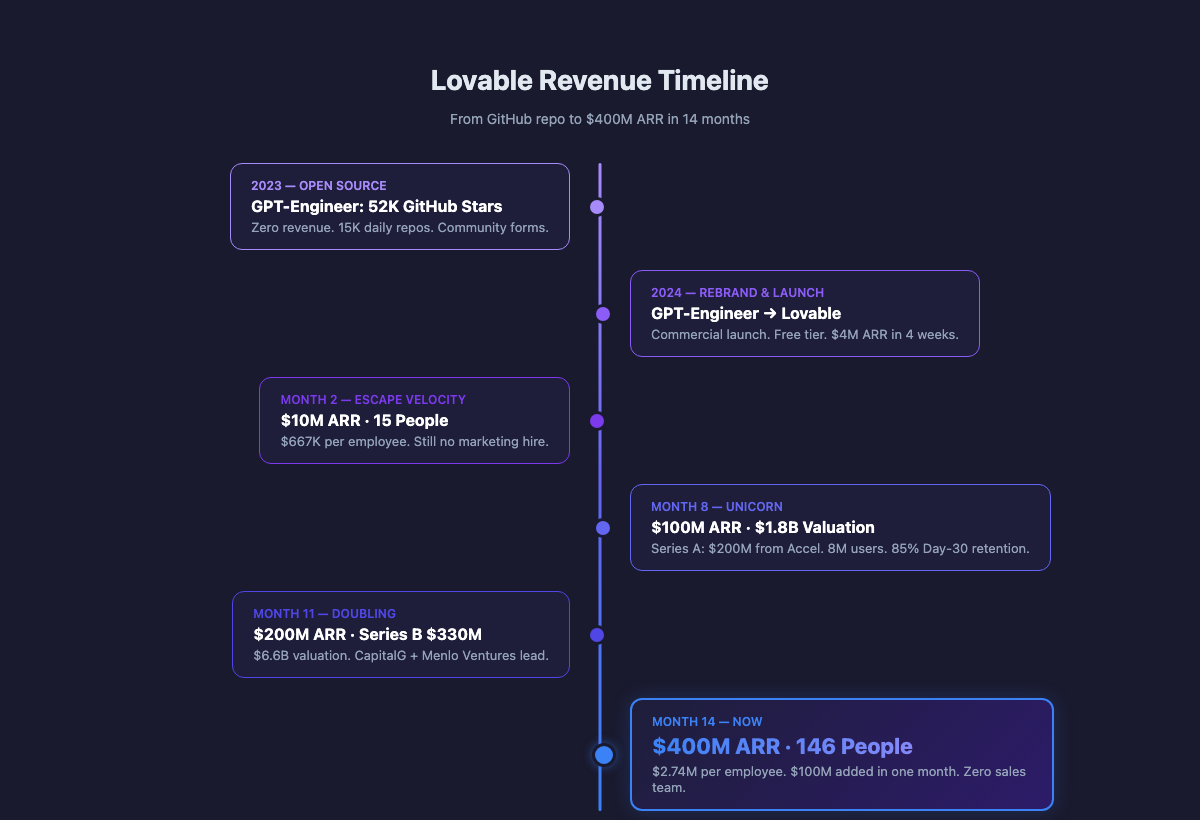
The numbers don't look real. Lovable went from $0 to $400M ARR in fourteen months, with 146 employees, no paid advertising, and no outbound sales team. At peak it added $2M of new ARR every week. That works out to $2.74M ARR per employee — roughly 7–10× the typical SaaS benchmark of $200K–400K.
It's tempting to file that under “great product.” The product is good. But plenty of good products never get found. What Lovable actually built was a distribution system— four layers that each fed the next, so every output became the next layer's acquisition channel. That's the part worth copying, and it's the part no one teaches builders.
It started with 52,000 stars and zero revenue
In mid-2023, Swedish AI researcher Anton Osika released an open-source project called GPT-Engineer. It hit 52,000 GitHub stars, 15,000 daily repository forks, and a 34,000-member Discord — before there was a business model, a landing page, or a dollar of revenue. The open-source repo wasn't a side project. It was the distribution engine: a free, zero-cost surface that put the product in front of tens of thousands of builders and earned 10 million monthly organic visits.
The rebrand that should've killed them
In early 2024, GPT-Engineer became Lovable— partly to dodge OpenAI's “GPT” trademark issues, partly because a memorable name travels further. The rename sacrificed SEO equity and brand recognition. Most growth teams would never do it. But a name that spreads is itself a distribution decision: they traded accumulated search juice for a brand people would actually repeat.
Anton Osika: the CEO who is the marketing department
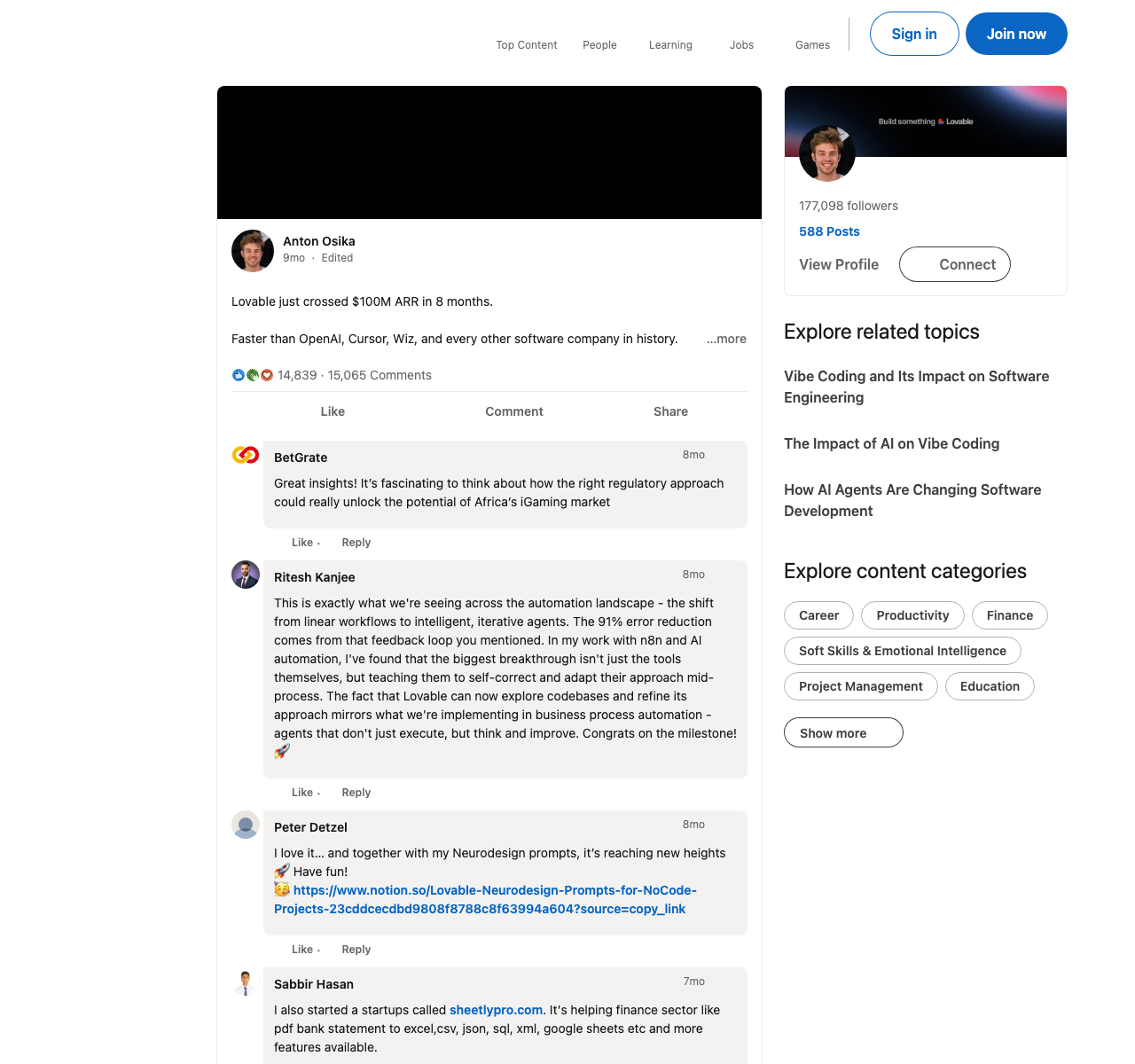
Lovable's first dedicated marketing hire didn't arrive until after $10M ARR. Until then, the founder was the channel. Anton posted on LinkedIn 2–3 times a week to 96,900 followers — earning an estimated 135,000–202,000 impressions a year — with a content principle he summed up as “transparency over perfection.”He shared real numbers, real decisions, and the messy middle. That builds the trust a paid ad can't buy, and it costs nothing but the founder showing up.
The four-layer distribution engine behind $400M ARR
Each layer existed to feed the next:
- Open source — the attention surface. 52K stars and 10M monthly visits, for free.
- The founder — the trust layer. Anton's voice converted attention into belief.
- The free product — the conversion engine. A free tier with daily credits got users to value in minutes; Day-30 retention hit 85%, versus the 20–40% typical of AI tools.
- The community and derived tools — the replication layer. Users became distribution nodes who brought in the next users.
That 85% retention isn't a loyalty trick. It's output permanence: ChatGPT gives you text you consume once; Lovable gives you an app with real features, users, and data — a thing you come back to. Real switching cost, not artificial lock-in.
“Meta-growth”: when your product markets your product
The sharpest move: Lovable used its own product to build tools whose only job was distribution.
- Launched — a Product Hunt-style showcase of apps built with Lovable. Every entry doubled as a testimonial, a proof point, and an acquisition surface.
- Linkable — a free personal-website generator. One Anton tweet produced 20,000 new sites in a week, and every site shipped with an “Edit with Lovable” button — a backlink and a discovery door pointing back to the product.
This is the Hotmail mechanism, rebuilt for AI tools: the product's own output recruits the next user. You don't pay for that distribution — you design it in.
$1M+ per employee — why “no sales team” is the point
Compare the org charts at $400M ARR. A traditional SaaS company would carry 500–800 employees, an 80–150-person sales team, $30–60M in annual selling cost, with 40–60% of revenue going to sales and marketing, and an 18–24 month payback. Lovable: 146 employees, zero salespeople, near-zero paid acquisition, $2.74M ARR per employee, and effectively instant payback because it's self-serve.
The “no sales team” isn't a cost-cutting flex. It's the evidence that distribution was solved upstream — in the product and the channel design — so it didn't need an army to push.
What most builders get wrong about distribution
- They treat distribution as a one-off launch, not a system. Lovable built a loop that kept running, not a campaign that ended.
- They hire an agency before they have a voice. Anton was the voice for the first $10M; no agency can manufacture founder credibility.
- They build in private. Lovable built in public for over a year and had 52,000 stakeholders before launch. You can't out-distribute someone who showed their work the whole way.
How to apply this even if you're not Lovable
- Turn your product into a distribution surface — give its output a link back to you.
- Make the founder the trust layer before you spend a dollar on ads.
- Build in public so launch day starts with an audience, not from zero.
- Optimize first-run value — retention is a distribution multiplier, because retained users refer.
The Runnax read
Lovable is the cleanest proof of the thing Runnax is built on: most builders don't have a product problem — they have a distribution problem.Lovable's product sat in a public repo for months; what turned it into $400M ARR was an engineered distribution system, not more output. The catch is that running that system — founder posts, the loop, the consistency — is exactly what gets dropped when you have a product to build. That's the execution gap Runnax closes: it diagnoses why customers aren't finding you, finds what actually works in your space (with real examples like this one), builds the deterministic system, and runs it — so distribution compounds while you stay building.
Sources: TechCrunch; Lenny's Newsletter; Lovable Blog; AI Native GTM; Sacra; Panto. External figures are reported from those sources and not independently verified by Runnax.