
By Kyan Gao, Co-Founder of Runnax. Built Runnax from 0 to serving multiple B2B companies. Serial entrepreneur, AI/SaaS background.
The Pitch That Got Hung Up On
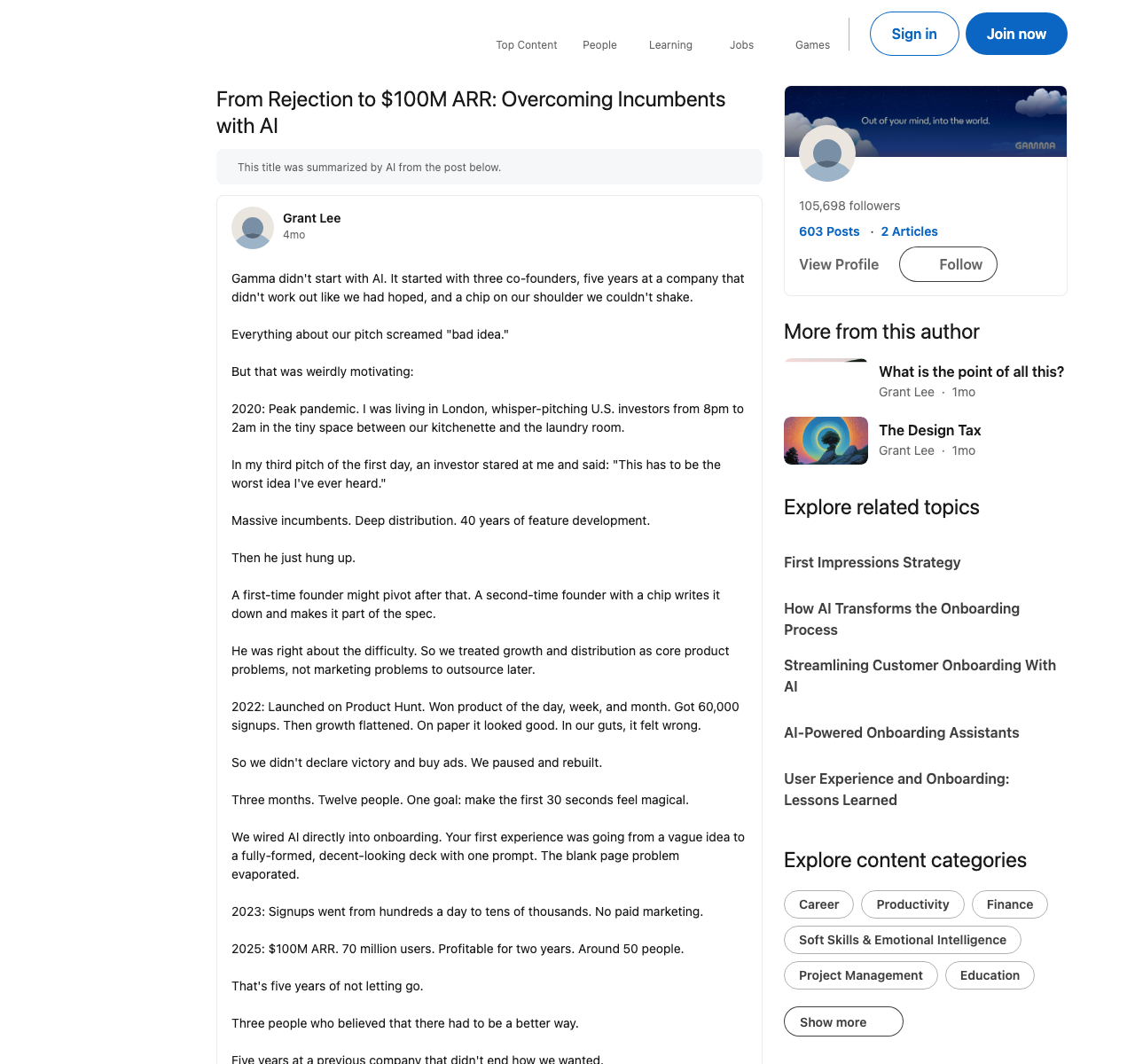
In 2020, Grant Lee got on a Zoom call with an investor and pitched his idea. The investor listened. Then said: "That has to be the worst pitch, worst idea I have ever heard." And hung up.
The idea? Build a better way to make presentations.
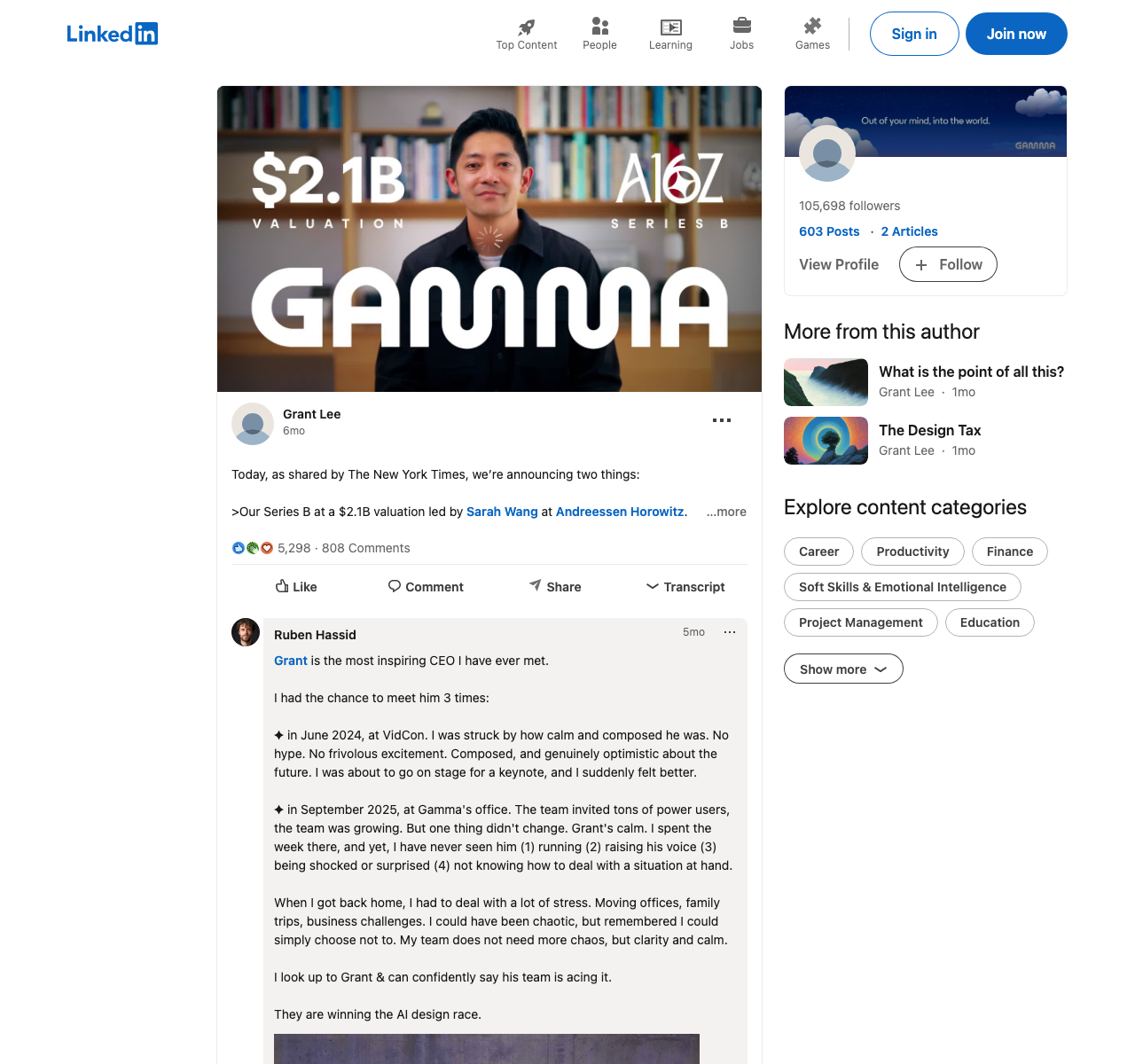
Five years later, that dumb idea is worth $2.1 billion, has 70 million users, and generates $100 million in annual recurring revenue. With 52 employees. Profitable for over two years straight.
I've tracked a lot of AI startup growth stories. What I noticed about Gamma is that almost none of their growth came from what most founders obsess over — no massive paid acquisition, no aggressive enterprise sales motion, no PR blitz. They grew through a very specific flywheel: obsessive onboarding, a micro-creator content army, and a free-tier design that made every user a walking billboard.
Let me break down exactly how they did it.
What Gamma Actually Is
Gamma is an AI-powered tool that lets you create presentations, documents, and web pages from a text prompt. Type a rough idea, and within seconds you have a fully designed, structured deck. No blank canvas. No formatting hell. No pixel-pushing.
The "Blank Page Problem" They Solved
Jon Noronha, Gamma's co-founder, describes it like this: "You get dropped into this blank canvas saying 'Enter presentation title,' and you spiral — outlining slides, figuring out your story, choosing fonts, colors, imagery. And you haven't even written anything yet."
That loop is familiar to anyone who's spent three hours on slide formatting before writing a single bullet point. Gamma turns the blank page into a near-finished rough draft. Your job becomes editing, not starting from scratch.
The Anti-PowerPoint Positioning
The positioning matters here. Grant Lee didn't call Gamma "a better presentation tool." He called it "the anti-PowerPoint." That framing signals a completely different philosophy — narrative-first instead of design-first, scrollable web formats instead of rigid slides, shareable links instead of email attachments. It gave Gamma a clear enemy to rally against, and made the product's existence feel necessary rather than incremental.
The Founding Story
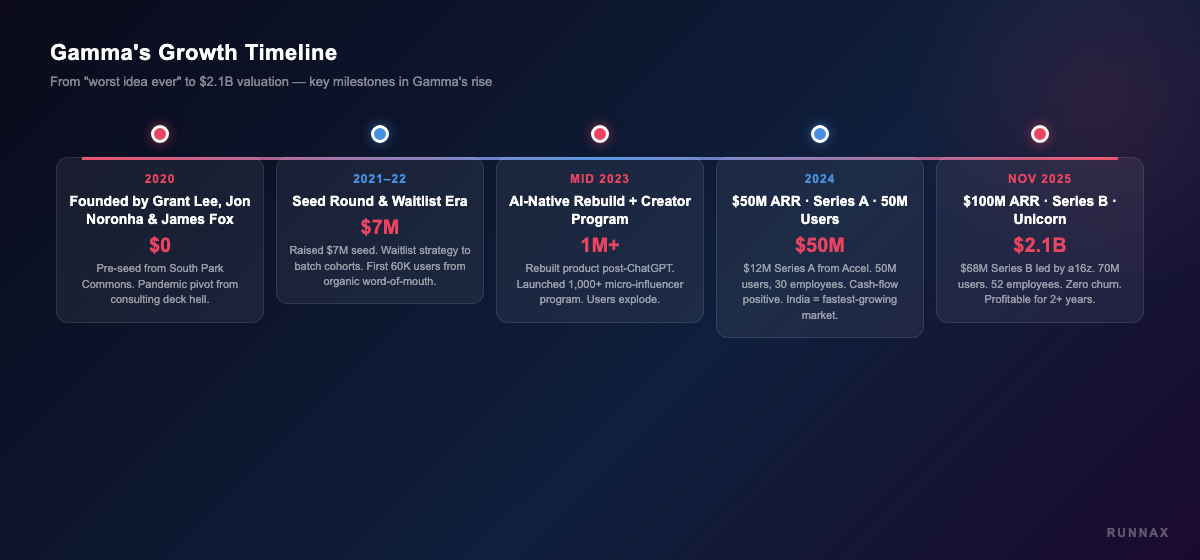
Grant Lee, Jon Noronha, and James Fox started Gamma in 2020. Grant had come from consulting, where he'd watched himself spend 90% of his time formatting slides and 10% on the actual content. Jon had been at Optimizely, building A/B testing infrastructure. James brought design chops.
The Early Bet
They raised a $7 million seed round. Then raised a quiet $12 million Series A from Accel in 2024. The total pre-Series B funding was just $23 million — a number that looks almost comically small against the $100M ARR they built on it. For comparison, plenty of Series A startups burn $23 million in 18 months without finding product-market fit.
The Waitlist Strategy
One early move that doesn't get enough credit: Gamma deliberately used a waitlist to batch new user cohorts during their early growth phase. Instead of opening the floodgates, they controlled the pace of signups. This sounds like artificial scarcity — but there was a real operational reason. It let them onboard users in manageable groups, gather feedback intensively, and iterate fast before the next wave came in. I'm not 100% sure this would work at every stage of a company, but for Gamma, it created a word-of-mouth pressure valve. People wanted in. Waiting made them more invested when they finally got access.
The AI-Native Rebuild That Changed Everything
Gamma existed before ChatGPT. They had a working product with a modest user base. But when ChatGPT launched at the end of 2022, the team made a decision that most established startups avoid: they rebuilt the entire product to be AI-native from the ground up.
What AI-Native Actually Means
Not "we added an AI feature to our existing tool." AI-native means the core value proposition changed. Before: Gamma was a collaborative, structured document builder. After: Gamma was a text-to-visual-content generator where AI did the heavy lifting on design and structure, and you did the thinking.
Jon Noronha's background at Optimizely proved useful here. The team ran hundreds of A/B tests across AI models, prompts, and output formats. What they found was counterintuitive: reasoning models actually hurt creativity. Claude excelled on taste and aesthetic output. Gemini won on cost efficiency. So they built a model orchestration layer — routing different tasks to different models based on the job to be done. That's a niche technical advantage that almost nobody talks about in the Gamma coverage I've read.
The Prompt Engineering vs. Fine-Tuning Decision
Jon made a deliberate choice to go deep on prompt engineering and model orchestration rather than fine-tuning their own models. His argument: fine-tuning locks you to a specific capability snapshot, while prompt engineering and orchestration stay flexible as the underlying models improve. Every time a new Claude model dropped, Gamma got better — for free. That's compounding product improvement with zero engineering effort.
The "First 30 Seconds" Obsession
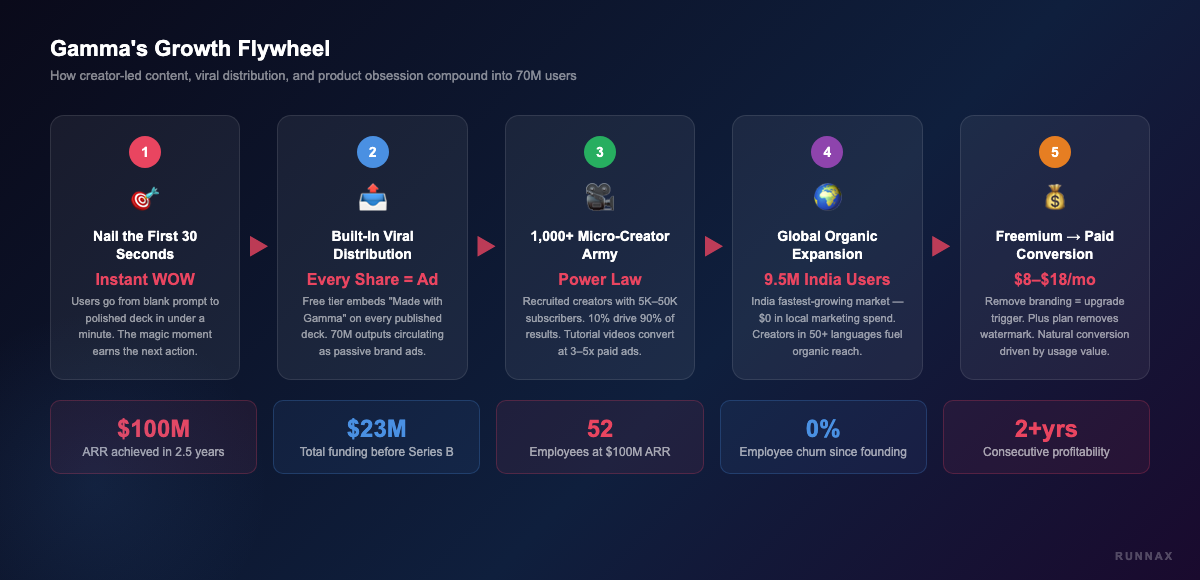
Here's the one operational decision I think was most responsible for Gamma's growth, and it's the one that gets the least ink: their obsession with the first 30 seconds of the user experience.
When Growth Stalled, They Fixed Onboarding
At one point in Gamma's early growth, signups were coming in but activation wasn't following. New users were bouncing. Grant said the team stopped everything — all features, all roadmap work — and spent weeks exclusively on the onboarding flow. The goal was simple: get users to a "wow moment" within the first 30 seconds of using the product.
"We can get you there and you can start playing around with it within the first 30 seconds of onboarding," Grant has said. That's not a marketing tagline. That was literally the product spec for their onboarding team.
Why This Drove Content Growth
The connection to content growth is direct. When someone has a magical first 30 seconds with a tool, they tell people about it. They post about it. They make tutorial videos. The product creates its own content supply chain. Gamma's early viral moments on TikTok and YouTube weren't manufactured — they were the natural result of people experiencing something genuinely surprising and wanting to share it. This is a distribution strategy, but it lives inside the product. You can't buy your way to this with ad spend.
The Micro-Creator Army, Not Macro Influencers
This is where Gamma's content strategy gets really interesting. Most SaaS companies, when they try influencer marketing, go for the big fish. Get someone with a million followers, pay them a lot of money, hope for the best. Gamma did the opposite.
The Power Law Insight
Grant Lee discovered something about creator performance that changed their entire distribution strategy: the relationship between creator audience size and conversion rate follows a power law — but not in the direction you'd expect. Micro-creators with 5,000 to 50,000 subscribers consistently outperformed macro influencers on actual user acquisition. Their audiences were more targeted, more trusting, and more likely to actually try the tool after watching a tutorial.
So Gamma recruited over 1,000 micro-influencers. Not 10 big names. Over a thousand small ones. Grant has noted that within that group, roughly 10% of creators drive 90% of the results. Instead of being selective upfront — which is the conventional wisdom — they went wide, let the data identify the top performers, and then doubled down on those relationships.
Tutorial-First, Not Hype-First
The content format mattered too. Gamma didn't ask creators to hype the product. They asked creators to teach it. "Here's how I made a sales deck in 3 minutes" converts better than "This AI tool is amazing." Tutorial content demonstrates the product working. It answers the skeptic's first objection — "does this actually work?" — before the user even signs up. And tutorial videos have long shelf lives. A YouTube walkthrough from 2023 still drives signups today.
Built-In Viral Distribution — The "Made with Gamma" Loop
Look, most tools with a free tier use branding as an upgrade incentive. "Remove our watermark, pay us money." Gamma does this too — but the framing is different in practice. Because every presentation shared from the free tier carries a "Made with Gamma" badge visible to the viewer. And the viewer can click it.
250 Million Presentations as Passive Ads
Gamma has had over 250 million presentations created on the platform. That's 250 million potential discovery moments, 250 million cases where someone in a meeting, reading a shared deck, or browsing content sees a Gamma-made presentation and thinks "wait, how did they make that?" It's the same mechanism that made Hotmail grow in the late 90s — every email had "Get your free email at Hotmail" in the signature. Every Gamma deck has a built-in invitation.
The Upgrade Trigger
The pricing structure is smart here. The free plan includes 400 AI credits to start, which is enough to create a few presentations and experience the product fully. But to remove Gamma branding and get unlimited AI generation, you upgrade to Plus ($8/month) or Pro ($18/month). The upgrade trigger isn't artificial scarcity — it's a natural desire to present professionally without a watermark. That's a pull conversion, not a push one.
The India Surprise: 9.5M Users, $0 Spent
One of the more remarkable data points in Gamma's story: India became their fastest-growing market with 9.5 million users — and not a single dollar of marketing spend in the country. Grant Lee acknowledged this directly: "That tells us how AI-native the market already is."
What Actually Drove India Growth
The India growth came through the creator program. Tutorial creators across South Asia picked up Gamma independently and made content for their audiences. Students, educators, entrepreneurs, solopreneurs — the "prosumer" segment Grant describes — found the product through YouTube searches in Hindi, Tamil, Telugu. Gamma's tool solved a real problem for people who needed professional-looking presentations but didn't have design backgrounds or expensive software licenses.
This is a pattern I've seen play out at Runnax too — when you build content that genuinely teaches rather than pitches, international markets find you without any deliberate targeting. The content does the geo-expansion work.
Growth Metrics Breakdown
| Metric | Value | Context |
|---|---|---|
| Annual Recurring Revenue | $100M+ | Achieved in ~2.5 years from AI-native launch (2023) |
| Total Users | 70 million | As of November 2025; India is fastest-growing market at 9.5M |
| Employees at $100M ARR | 52 | ~$1.9M ARR per employee — exceptional capital efficiency |
| Total Funding Before Series B | $23 million | Seed ($7M) + Series A ($12M Accel) + pre-seed |
| Series B Valuation | $2.1 billion | Led by Andreessen Horowitz, November 2025 |
| Series B Raise | $68 million | Includes $20M secondary for employee liquidity |
| Profitability Track Record | 2+ years consecutive | Cash in bank exceeds total VC raised (pre-Series B) |
| Employee Turnover | 0% | Zero attrition since founding — all 10 original employees still there |
| Micro-Creators in Program | 1,000+ | Focused on 5K–50K subscriber range; 10% drive 90% of results |
| Presentations Created | 250 million+ | Each shared presentation is a potential acquisition touchpoint |
The Hiring Philosophy Most Founders Get Wrong
And here's the part of Gamma's story that doesn't get nearly enough attention: they have zero employee turnover since founding. Every person they've ever hired is still there. In the AI startup world of 2024–2025, where talent churn runs hot and companies double headcount after every funding round, this is almost surreal.
Hire Painfully Slow
Grant's philosophy is explicit: "Hire painfully slow." When startups hit product-market fit, the natural temptation is to staff up fast. Investors expect it. Your metrics justify it. But Gamma actively resisted. "There is a temptation — you raise a big round, you hit product-market fit, and suddenly you want to double or triple the team within a year. But we've never leaned into that," Grant has said.
The result: a small, high-trust, high-ownership team. Grant has noted that a quarter of Gamma's team are designers — an unusually high ratio for a software company. The bias toward generalists who can stretch across functions means each hire carries more weight.
No 996. Actual Culture.
Gamma explicitly rejected the 996 work culture (9am to 9pm, 6 days a week) common in some AI startup environments. Grant talks about wanting a "genuinely fun, quirky, creative" culture. I'm skeptical of startup culture branding as a general rule — but when you have zero attrition for five years, the data backs up the claim. People aren't performing culture. They're staying.
Creator-Led Growth vs. Traditional SaaS Marketing
Without Creator-Led Content
- Paying $15–$50 CPCs on Google/Meta ads to reach cold prospects
- Building an in-house content team of 5–10 people before revenue justifies it
- SEO takes 12–18 months to generate meaningful organic traffic
- Sales team needed to explain and demo the product at every conversion
- Brand awareness stays within your immediate marketing reach
- International expansion requires local marketing hires and budgets
- Each new user acquisition is a fresh cost
With Gamma's Creator-Led Approach
- 1,000+ micro-creators producing tutorial content in their own voice
- Each tutorial video earns views for years — compounding return
- Product discovery happens inside trusted communities, not ads
- Tutorial content pre-answers objections before users sign up
- Viral distribution built into the free tier — every shared deck is an ad
- India: 9.5M users acquired with $0 in local marketing spend
- Organic content flywheel grows without proportional cost increase
What I'd Do Differently If I Were Running This
But here's something I keep coming back to: Gamma's creator program is brilliant, but it's also replicable. Any AI productivity tool with decent UX can recruit 1,000 micro-creators. The harder-to-copy advantages are the product ones — the AI-native rebuild, the first-30-seconds obsession, the model orchestration layer. Those require years of accumulated learning that competitors can't shortcut.
If I were building Gamma today, I'd be thinking hard about what happens when every AI tool has a creator program. The differentiation in content distribution gets commoditized fast. At Runnax, we've seen this dynamic — when everyone's doing the same content motion, the quality of individual pieces starts to matter more than the quantity. That's where tools like Runnax become critical: not just producing more content, but producing strategically differentiated content that an army of generic tutorial creators can't replicate.
I'd also push harder on community, not just creator. Gamma has creators making content about Gamma. What they don't have yet (as far as I can tell) is a tight community of power users who co-create the product roadmap publicly. That's what Notion did with its template creators and super-users. It's a different kind of moat — one built on relationships rather than distribution.
For founders following similar playbooks, tools like Runnax can accelerate this creator-enablement layer — helping you brief creators with better content briefs, track what's working across 1,000 micro-channels, and identify the 10% of creators driving 90% of results before you've watched three months of data accumulate.
Lessons for B2B Founders
Five things I'd pull from Gamma's story directly:
1. The First Moment Is a Distribution Strategy
Gamma's "first 30 seconds" obsession isn't just good UX — it's their content engine. Every magical first experience becomes a potential creator's first video. Fix onboarding before you fix distribution. The product creates the content supply chain.
2. Build Distribution Into the Free Tier
The "Made with Gamma" branding on free outputs isn't just a monetization lever. It's a passive acquisition channel running at zero cost. If you have a free tier, ask yourself: is every output from your free users putting your product in front of a new potential user? If not, you're leaving distribution on the table.
3. Micro Over Macro, Always
I've tested this at Runnax too. A creator with 12,000 engaged followers in a specific niche will out-convert a creator with 500,000 general-interest followers almost every time. The trust and context specificity matter. Go wide, let data identify your winners, then invest in those relationships. Don't curate upfront — you'll get it wrong.
4. Staying Lean Isn't Just Cost Control
Gamma's 52-person team at $100M ARR isn't just a capital efficiency story. It's a culture story and a speed story. Every extra hire adds coordination overhead. Gamma can ship fast because the team is small enough for everyone to know what everyone else is working on. The constraint is the advantage.
5. The Contrarian Positioning Pays Off
Everyone told Grant the presentation market was saturated. PowerPoint has 500 million users. Canva was growing fast. What the critics missed: saturated markets have large audiences of frustrated users. Positioning against the incumbent — "the anti-PowerPoint" — gave Gamma a narrative that spread on its own. You don't need a new market. You need a contrarian take on an existing one.
That's a pattern I keep pointing back to in this series. Whether it's how Clay scaled from $1M to $100M ARR on content alone, or how Lovable hit $400M ARR without a sales team, the companies breaking through in competitive categories are almost always the ones with a clearly stated contrarian bet. Gamma's was: "PowerPoint has been around 40 years. We want to be the standard for the next 40."
And for anyone building content strategy for a B2B tool right now, I'd recommend reading our breakdown of how Notion grew from a dying startup to a $10B company using community-driven content. The parallels to Gamma's playbook are striking.
Frequently Asked Questions
How did Gamma reach $100M ARR with only 52 employees?
Gamma combined extreme capital efficiency with a product-led growth motion that didn't require a large sales or marketing team. Their micro-creator program outsourced distribution to 1,000+ independent creators, while the "Made with Gamma" branding on free-tier outputs created a self-sustaining acquisition loop. They also stayed lean on headcount by design — Grant Lee's philosophy of hiring "painfully slow" meant every person carried significant ownership and responsibility, keeping coordination costs low.
What is Gamma's micro-influencer strategy and why did they avoid large creators?
Gamma recruited over 1,000 creators in the 5,000–50,000 subscriber range rather than a small number of large influencers. The key insight was that micro-creators have more targeted, trusting audiences who actually try the products they recommend. Grant Lee discovered a power law within this group: 10% of creators drove 90% of the conversions. By going wide first and using data to identify high performers, Gamma could double down on the right relationships rather than betting on a few expensive macro deals upfront.
How does Gamma's free tier drive organic growth?
Every presentation created on Gamma's free plan carries "Made with Gamma" branding visible to anyone who views the shared deck. With over 250 million presentations created on the platform, this creates a massive passive discovery channel. Viewers who see a well-designed presentation and wonder "how did they make that?" can click directly to Gamma. It's the same viral loop that made Hotmail and Dropbox grow — distribution baked into the product output rather than bolted on through ads.
Why did Gamma rebuild the product to be AI-native after ChatGPT launched?
Before ChatGPT's arrival, Gamma was a structured document builder with modest traction. The team recognized that large language models fundamentally changed what was possible in their core use case — going from blank prompt to finished presentation. Rather than adding AI features to their existing product, they rebuilt around AI as the primary interaction model. This meant the "blank page problem" — the most painful friction in presentation creation — could be eliminated in seconds. That product change created the wow moment that then powered their creator-driven content flywheel.
What can B2B SaaS founders take from Gamma's growth model?
Three things stand out. First, fix the first experience before you fix distribution — if the product doesn't create a genuine wow moment, no amount of creator content will compensate. Second, build distribution into your product outputs. If you have a free tier, ask whether every file, link, or output carries a brand touchpoint. Third, go wide on creator outreach rather than curating upfront. The creator who drives the most signups for your product might have 8,000 subscribers in an obscure niche. You won't know until you let the data tell you.
Related reading:
- How Clay Went from $1M to $100M ARR Using Content Instead of Ads
- How Lovable Went from a GitHub Repo to $400M ARR Without a Sales Team
- How Notion Grew from a Dying Startup to a $10B Company Using Community Content
If you're a B2B founder trying to build a content growth engine without a 20-person marketing team, See How Runnax Powers Content-Led Growth →
Sources: TechCrunch – Gamma $2.1B valuation announcement, Economic Times – India fastest-growing market for Gamma, Sequoia Capital Training Data – Jon Noronha on scaling to $50M ARR, Accel – Series A investment announcement, The New York Times – Gamma raises $68 million Series B, The Split Podcast – Grant Lee on $50M ARR with 30 employees