
By Kyan Gao, Co-Founder of Runnax. 20 years in B2B content growth. Built a 1M+ audience as a founder creating content firsthand. Helped 200+ founders go from invisible to recognized industry voice.
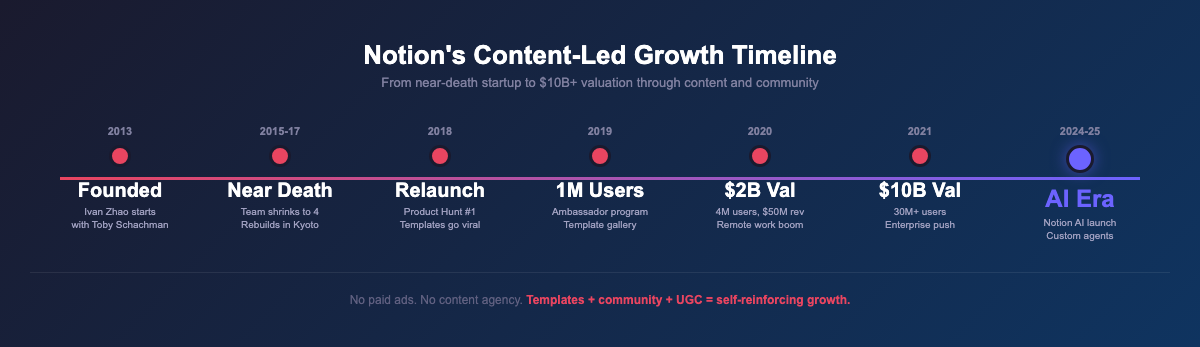
Notion almost died in 2015. The team had burned through their runway, moved to Kyoto to survive on a cheaper cost of living, and rebuilt the product from scratch. No funding. No press. No marketing team.
By 2021, they raised at a $10 billion valuation. By 2024, they had over 30 million users across 200+ countries.
Here’s the part most people get wrong about that story: Notion didn’t grow because they had a better product than Evernote or Confluence. They grew because they built a content ecosystem that made other people do their marketing for them — for free, at scale, and with more credibility than any ad campaign could produce.
This is a breakdown of exactly how they did it. What worked, what the numbers look like, and — more importantly — what founders building in 2026 can actually steal from the playbook.
The Near-Death Experience That Changed Everything
In 2015, Notion had a product that barely worked and a team that was hemorrhaging money. Ivan Zhao and Simon Last made a decision that most founders would never make: they stopped trying to grow and focused entirely on building something that deserved to grow.
They moved to Kyoto. Cut costs to almost nothing. Rewrote the codebase from the ground up. This wasn’t a pivot story — it was a quality bet. They believed that if they built something genuinely different, the product itself would carry the story.
When they relaunched in 2018, they did something unusual for a SaaS company at the time: they didn’t run ads. They didn’t hire a VP of Marketing. They made it easy for users to share what they’d built — and let the internet do the rest.
That decision to trust product quality and user creativity over paid acquisition is the foundational choice that everything else in this breakdown traces back to.
The Growth Numbers Nobody Puts in One Place
| Year | Milestone | Valuation / ARR | Key Driver |
|---|---|---|---|
| 2016 | Product rebuilt, small alpha launch | — | Word of mouth among designers |
| 2018 | Public relaunch, Product Hunt #1 | ~$2M ARR (est.) | Product Hunt + early template sharing |
| 2019 | Crossed 1M users | $800K seed raised | Community growth, YouTube tutorials |
| 2020 | Pandemic-fueled remote work adoption | $50M raised, $2B valuation | Template ecosystem explosion |
| 2021 | 10M+ users, global expansion | $275M raised, $10B valuation | Ambassador program, UGC, B2B push |
| 2022 | Notion AI launched in beta | ~$67M ARR (est.) | AI interest wave, press coverage |
| 2023 | Notion AI general release | ~$100M ARR (est.) | AI upsell, enterprise deals |
| 2024 | 30M+ users, 200+ countries | $10B+ valuation maintained | Enterprise expansion, ecosystem depth |
A few things jump out when you lay these numbers out. First, Notion’s 2020 inflection wasn’t luck — it was a prepared ecosystem catching a tailwind. The template library already existed. The community was already active. When remote work exploded, Notion had a content infrastructure that was ready to absorb the attention.
Second, their ARR-to-valuation ratio looks odd on paper. The $10B valuation in 2021 on what was probably ~$30-40M ARR reflects how much investors were pricing in the network effects of their content ecosystem — not just the subscription revenue.
How the Template Ecosystem Became a Free Sales Force
This is the centerpiece of the whole Notion story, and I don’t think most people understand quite how deliberately it was designed.
Notion’s template gallery isn’t a feature. It’s a content distribution system with a product attached.
Here’s how it actually works as a growth engine:
Someone builds a Notion workspace — a CRM, a content calendar, a habit tracker, a project management board. They share it as a template. That template gets duplicated by thousands of people. Each duplication is essentially a product demo that requires zero effort from Notion’s team. The person using the template sees what Notion can do, gets immediate value, and often upgrades to a paid plan to unlock collaborative features.
By 2023, Notion’s template gallery had over 10,000 community-created templates. That’s 10,000 pieces of interactive marketing content that Notion didn’t pay a cent to create.
The genius move was making templates shareable with a single link. That one product decision turned every power user into a distribution channel. A student shares their study system. A founder shares their startup OS. A designer shares their client portal. Each share is a cold acquisition that feels like a warm recommendation.
And here’s something most SaaS companies completely miss: templates rank on Google. Search “Notion CRM template” or “Notion content calendar template” and you’ll find Notion’s own gallery pages, but also hundreds of third-party blog posts, YouTube videos, and Reddit threads — all driving organic traffic back to the product.
The template ecosystem is simultaneously a product feature, a content strategy, a community activation tool, and an SEO play. That’s rare. That’s the kind of compounding content asset that I talk to founders about at Runnax constantly — the difference between creating content and building content infrastructure.
The Community Flywheel: Ambassadors, Subreddits, and YouTube
Notion’s community didn’t happen organically. Parts of it did — but the Ambassador Program was deliberate.
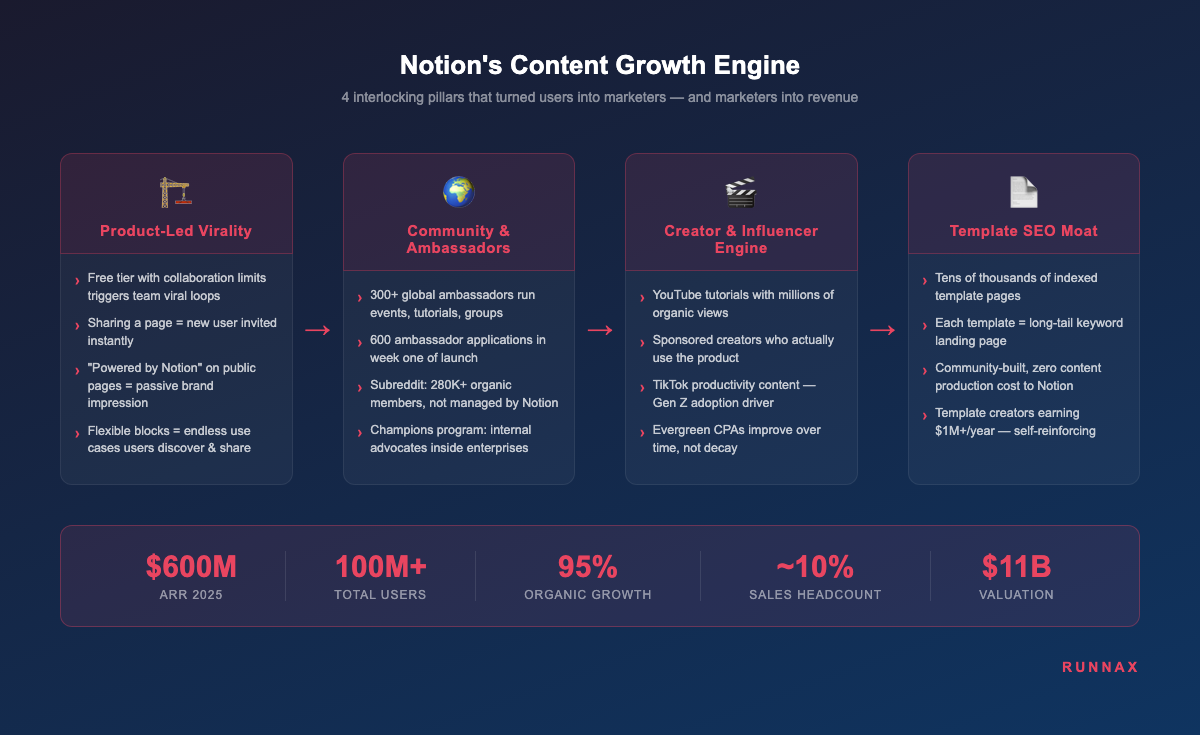
Launched around 2020, the Notion Ambassadors program identified power users who were already creating content about Notion and gave them early access, direct lines to the product team, and recognition. Not money — recognition and access. That’s a key distinction.
The result: a global network of creators who made YouTube tutorials, wrote newsletter breakdowns, hosted workshops, and shared templates — all without being on Notion’s payroll.
The r/Notion subreddit hit 300,000+ members. YouTube search for “Notion tutorial” returns millions of results from independent creators. These creators had their own audiences, their own credibility, and their own motivations. Notion just gave them the fuel.
This is the flywheel structure:
- Power users create content about Notion → new users discover Notion through that content
- New users become power users → some of them create content
- More content means more discovery → more users means more templates and community posts
- More templates and community posts mean more SEO surface area → more organic discovery
Notice what Notion doesn’t have to do at each stage: create the content, pay for the distribution, or manage the community directly. They built the conditions for the flywheel to spin and then stayed mostly out of the way.
Notion’s SEO Engine: Product Pages as Content
Notion’s approach to SEO is understated and underanalyzed.
They don’t publish a blog-heavy content strategy in the traditional sense. Their SEO strength comes from three different sources that compound each other:
1. Template gallery pages. Each template in their gallery is an indexed page. With thousands of templates, that’s thousands of pages targeting long-tail queries like “meeting notes template,” “OKR tracker template,” “personal CRM Notion.” These pages convert at high intent because the person searching is already looking for exactly what Notion offers.
2. User-generated public pages. When users make their Notion pages public, those pages get indexed. Notion’s help documentation, product changelogs, and even some company wikis live on public Notion pages — which means Notion.so is a massive, constantly-updated content publishing platform where they don’t write most of the content.
3. Third-party content responding to brand search. Because the community is so active, there’s an enormous ecosystem of “Notion vs. Airtable,” “best Notion templates for students,” “how to use Notion for project management” content from independent creators. Notion benefits from all of this without producing it.
According to Ahrefs estimates, notion.so pulls in over 3 million monthly organic visitors. A significant portion of that traffic is driven by community-created content and template pages — not Notion’s own editorial team.
This is what I mean when I say their content strategy isn’t a content strategy in the traditional sense. They built a platform that generates content. Most companies try to hire their way to content scale. Notion engineered it.
Ivan Zhao’s Quiet Founder Brand
Ivan Zhao is not a typical founder-influencer. He doesn’t post daily LinkedIn hot takes. He doesn’t have a massive Twitter following. He doesn’t speak at every conference.
But his founder brand is actually quite deliberate — and its quietness is part of the strategy.
Zhao’s rare interviews are consistently about craft, taste, and the philosophy of tools. He talks about Notion as a “tool for thought” — language borrowed from computing pioneers like Douglas Engelbart. He references art, design history, and human creativity in interviews with publications like The Verge and Wired. He positioned Notion not as productivity software but as a medium for thinking.
That positioning did something critical: it attracted a specific type of early user — people who cared about how they think, work, and create. Writers, designers, developers, researchers, founders. These are people with audiences. People who share the tools they love. People who write about their workflows publicly.
The founder’s intellectual brand shaped the product’s early adopter profile. And that early adopter profile was uniquely suited to generating the content flywheel Notion needed.
There’s a lesson here that I’ve seen play out repeatedly with founders I work with through Runnax: the way you talk about your product attracts a certain type of customer. If you talk about ROI and efficiency, you attract procurement-minded buyers. If you talk about craft and possibility, you attract evangelists.
Why UGC Did More Than Any Blog Post
Let me be specific about what user-generated content did for Notion that their own content couldn’t do.
When Notion’s team describes what Notion is, it sounds like a pitch. When a startup founder shows their entire company operating system built in Notion — that’s proof. It’s a different category of content entirely.
The most viral Notion content over the years has been:
- YouTube videos of elaborate personal knowledge management systems
- Twitter threads showing startup dashboards and founder operating systems
- Reddit posts asking “how do you use Notion for X?” — which generate hundreds of responses, each one a mini-case study
- Blog posts from individuals documenting their Notion setup evolution
- Newsletter sections where writers share their Notion templates with subscribers
None of this was scripted by Notion. All of it built trust with potential users more effectively than any polished marketing copy could.
The mechanics of why this works: UGC carries social proof + specificity + authenticity simultaneously. A blog post from Notion saying “you can manage your projects in Notion” is generic. A video from an indie founder showing exactly how they manage client work, track revenue, and plan their week in Notion — that’s specific, credible, and personally relevant to a viewer who has those same problems.
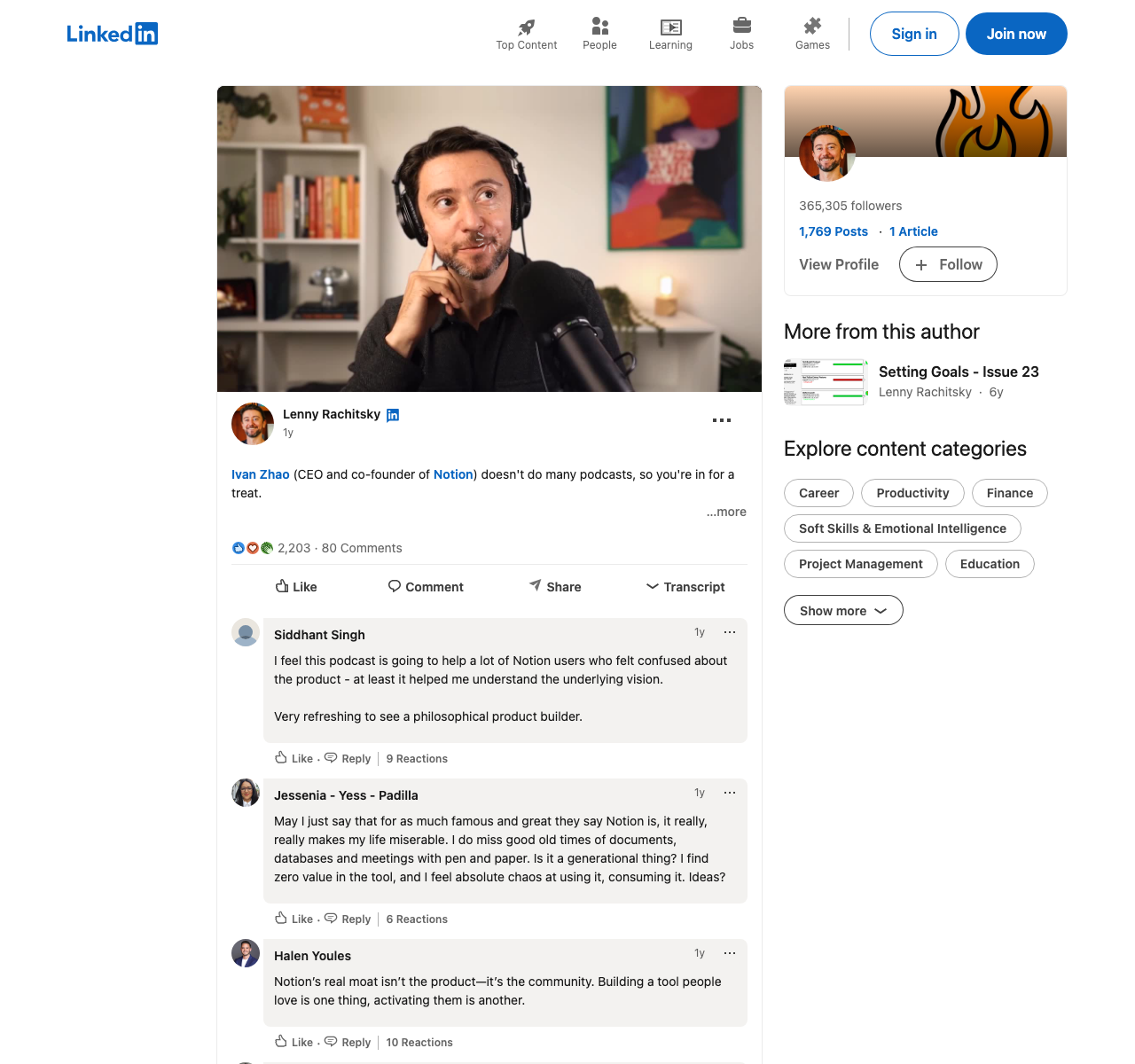
The data on this is pretty clear. Nielsen research consistently shows that 92% of consumers trust peer recommendations over brand advertising. Notion effectively turned their entire user base into peer recommenders by making it trivially easy to share workspaces, templates, and tutorials.
How Freemium and Content Worked Together
Notion’s freemium model and their content strategy are inseparable. You can’t understand one without the other.
The free plan was always generous enough to be genuinely useful — especially for individual users. That mattered enormously because individual users are the ones who create content about tools. They write blog posts, make YouTube videos, share templates. They don’t have procurement departments or legal review processes slowing down their ability to evangelize publicly.
The friction to start using Notion was near zero. The friction to share your Notion workspace was near zero. The friction to create a template and publish it was near zero.
Low friction at every content-creation and sharing touchpoint is what made the UGC flywheel spin so fast. Compare this to enterprise-first SaaS products where sharing a case study requires legal approval from three departments — you can see why those products don’t generate organic UGC at scale.
Without Content-Integrated Product Design
- Users stay in silos — no sharing mechanism
- Growth depends on paid acquisition
- Marketing team creates all content
- Each customer acquisition is a standalone cost
- Content volume limited by headcount
- No compounding SEO surface from users
With Content-Integrated Product Design (Notion’s Approach)
- Every user is a potential content creator + distributor
- Growth compounds through sharing mechanics
- Community creates content at scale without payroll
- Each customer can bring in N more customers
- Content volume scales with user base
- Tens of thousands of indexed pages from user activity
Notion’s freemium tier was also the thing that made their template sharing work. You can duplicate a template on the free plan. That means a power user on a paid plan creates a template, shares it, and thousands of free users copy it — getting exposed to Notion’s full feature set in context, and then upgrading when they hit real collaboration needs.
The template is a free trial with better UX than any product tour.
The B2C-to-B2B Crossover Nobody Planned
This part of the Notion story is genuinely interesting and a bit counterintuitive.
Notion didn’t start with an enterprise strategy. They built for individuals — students, freelancers, side project founders, writers. The early community was heavily personal-use oriented. That’s why the content (tutorials, templates, personal OS setups) was so individual-focused.
But something kept happening: individuals who used Notion in their personal lives started bringing it into their companies. Not through top-down IT decisions — through bottom-up adoption. An engineer sets up a team wiki in Notion. A designer shares a project tracker with their client. A founder puts their roadmap in Notion and invites their first hires.
This is the classic product-led growth B2C-to-B2B crossover. But Notion’s content strategy accelerated it in a specific way: the individual-use content (tutorials, personal templates) gave people confidence in the tool before they brought it to work. The learning curve was already cleared. The switching cost was already justified in the person’s mind.
By the time Notion started actively pursuing enterprise, they had thousands of companies already using it — not because of enterprise sales, but because employees who loved the product at home brought it to work.
That individual-first content ecosystem was, in hindsight, the cheapest enterprise sales motion ever built.
This is something the team at Runnax has noticed across multiple SaaS case studies: the most efficient enterprise pipelines often start with individual-user content that builds personal trust long before a procurement conversation starts.
What Didn’t Work (And What Notion Got Lucky With)
I want to be honest here because most growth breakdowns are too clean. Notion made real mistakes and had real luck.
What didn’t work:
Performance for large databases. For years, Notion had significant performance issues with large amounts of data. Users complained constantly. This became a community content problem too — negative reviews, Reddit complaints, YouTube videos about Notion’s slowness. The community that amplified Notion’s strengths also amplified its weaknesses. Notion eventually addressed the performance issues but it cost them credibility during a critical growth phase.
Offline mode (for a long time). Notion was cloud-only with poor offline support for years. This was a real limitation that power users documented publicly — again, the two-edged sword of a vocal community.
Enterprise features lagged. When enterprise customers started adopting Notion bottom-up, the product wasn’t actually ready for enterprise requirements around permissions, security, and compliance. They had to build backward from a consumer product to enterprise specs, which is harder than the reverse.
What they got lucky with:
COVID timing. The 2020 remote work explosion happened right when Notion’s community and template ecosystem had enough momentum to absorb the surge. Six months earlier or later, the outcome might have been different.
The “second brain” trend. The personal knowledge management (PKM) movement — popularized by people like Tiago Forte with his Building a Second Brain framework — created enormous demand for exactly the kind of flexible, linked-database tool Notion offered. Notion didn’t create that trend, but they benefited enormously from it.
YouTube creators who happened to pick Notion. A handful of large productivity YouTubers — Thomas Frank being the most prominent — built significant content businesses around Notion. Thomas Frank Explains now has millions of subscribers, largely built on Notion content. That wasn’t Notion’s doing. They were fortunate that talented creators organically aligned with their product.
6 Actionable Lessons for SaaS Founders
I’ve spent a lot of time breaking down what Notion did. Now let me translate it into what you can actually use.
1. Build sharing into the product, not onto it.
Notion’s share link isn’t a marketing feature — it’s a core product behavior. Every workspace is shareable by default. If your product doesn’t make sharing trivially easy, you’re leaving your biggest acquisition channel on the table. Ask yourself: what does a user create in my product that they’d want to show someone else? Then make that thing one click to share.
2. Create the conditions for content, not just content.
Notion didn’t hire a huge content team. They built a template gallery, an ambassador program, and a community infrastructure. The community created the content. Your job as a founder isn’t to produce all the content — it’s to build the environment where your users want to create content about you. That might mean a community forum, a template library, a user showcase page, or an ambassador program.
3. Your early adopters are your distribution network — choose them intentionally.
Ivan Zhao’s “tools for thought” positioning attracted a specific kind of early user: creators and thinkers with audiences. That was intentional, even if not always consciously so. Think about who your ideal early adopters are — not just as customers, but as potential content creators and evangelists. A freelancer with a newsletter is worth more in content value than a mid-market enterprise with no social presence.
4. Make your product’s output shareable, not just the product itself.
Notion templates are what’s shared — not a referral link, not a coupon code. The output of using Notion is something people are proud to show. If the outputs of using your product are inherently shareable and impressive, you have a UGC engine. If they’re not — think hard about how to add a shareable artifact to your user journey.
5. Treat freemium as content infrastructure, not just a conversion funnel.
Notion’s free tier creates content creators. Individual users on free plans make templates, write tutorials, post their setups — all driving acquisition. If you’re thinking about freemium purely as “how do I convert free users to paid,” you’re missing half the value. Ask also: does my free tier enable users to create content that markets my product?
6. Your founder voice sets the early adopter profile.
How you talk about your product determines who shows up. Notion’s philosophical, design-forward, “tools for thought” language attracted people who think carefully about how they work. Those people blog about their tools. They share their setups. They become evangelists. At Runnax, we help founders develop a content voice that attracts not just customers but the right kind of customers — the ones who bring others with them.
Related reading:
- How Clay Went from $1M to $100M ARR Using Content Instead of Ads
- How Lovable Went from a GitHub Repo to $400M ARR — Without a Sales Team
- AI Content Operations and Demand Generation: Why More Output Is Not the Goal
- From Zero to Trusted Expert: A 90-Day Founder Content Plan
Related Reading
If this breakdown resonated, these go deeper on the mechanics behind content-led growth:
- AI Visibility Strategy for B2B Brands: What Visibility Actually Means in AI Search
- How AI Can Generate a Month of On-Brand Founder Content Without Sounding Robotic
- Why Short-Form Video Has the Highest ROI in B2B Content Marketing (2026 Data)
- TikTok vs. LinkedIn Video for B2B Founders: Where Should You Invest First?
- What Is an AI Digital Avatar and Should Founders Use One for Content?
The pattern across all of these: content that compounds beats content that campaigns. Notion is the clearest proof case in SaaS history.
If you’re a SaaS founder thinking about how to build a content engine that doesn’t require a 10-person marketing team, that’s exactly the problem Runnax was built to solve. We work with founders to build the kind of compounding content infrastructure — founder voice, community conditions, template ecosystems — that made Notion’s growth possible even without a traditional marketing budget.
Build Your Content Growth Engine with Runnax →
Frequently Asked Questions
How did Notion grow without a traditional marketing budget?
Notion grew primarily through product-led content distribution: a shareable template ecosystem, a community ambassador program, and a freemium model that made it trivially easy for users to share their workspaces and setups publicly. Individual users created tutorials, YouTube videos, blog posts, and Reddit threads — all driving organic discovery without Notion spending on paid acquisition at scale.
What is Notion’s template ecosystem and why was it so important to their growth?
Notion’s template gallery is a library of community-created workspace templates — CRMs, project trackers, content calendars, habit systems — that any user can duplicate with a single click. By 2023 it had over 10,000 templates. It functions simultaneously as a product demo, an SEO asset, a community activation tool, and a content distribution channel — all without Notion’s marketing team creating or maintaining the content.
What role did the Notion Ambassador Program play in their growth?
The Ambassador Program identified power users who were already creating Notion content and gave them early access, product team relationships, and recognition. These ambassadors built audiences around Notion content — tutorials, templates, workflow breakdowns — independently and authentically. It’s a model where instead of paying for influencer marketing, Notion invested in community infrastructure that attracted self-motivated creators.
How did Notion cross over from individual users to enterprise customers?
The enterprise crossover was almost entirely bottom-up. Individual users who loved Notion in their personal lives brought it into their companies — setting up team wikis, project trackers, and shared databases without going through IT. Notion’s individual-focused content (tutorials, personal templates, workflow guides) pre-educated these users long before any enterprise sales motion began, effectively making the individual content ecosystem Notion’s cheapest enterprise pipeline.
What can early-stage SaaS founders realistically take from Notion’s content strategy?
Three things are immediately actionable regardless of stage: (1) make your product’s output shareable — give users something they’re proud to show others; (2) build a template or resource library early so your power users have a place to contribute; (3) let your founder voice attract the right early adopters — the ones who write, share, and evangelize. You don’t need an audience of millions. You need early users who naturally talk about the tools they love. Start there.
Sources: Notion About Page, TechCrunch, The Verge, Ahrefs, Nielsen Consumer Trust Research, Wired