
What You'll Learn
- The Numbers Nobody Believes
- It Started with 52,000 Stars and Zero Revenue
- The Rebrand That Should've Killed Them
- Anton Osika: The CEO Who IS the Marketing Department
- The 4-Layer Content Engine Behind $400M ARR
- Meta-Growth: When Your Product Markets Itself
- Why No Sales Team Is the Point
- The Retention Secret Most AI Tools Would Kill For
- What Most AI Startups Get Wrong About Content
- How to Apply This Even If You're Not Lovable
- FAQ
The Numbers Nobody Believes
I've been in B2B content for 20 years. I've seen fast growth. I've seen viral moments. I've never seen anything like Lovable.
$4 million ARR in week four. $10 million by month two. $100 million by month eight. And then they kept going.
| Milestone | Timeline | Team Size | Revenue per Employee |
|---|---|---|---|
| $4M ARR | Week 4 | 15 | $267K |
| $10M ARR | Month 2 | 15 | $667K |
| $17M ARR | Month 3 | ~20 | $850K |
| $50M ARR | Month 5 | ~40 | $1.25M |
| $100M ARR | Month 8 | ~80 | $1.25M |
| $200M ARR | Month 11 | ~100 | $2M |
| $400M ARR | Month 14 | 146 | $2.74M |
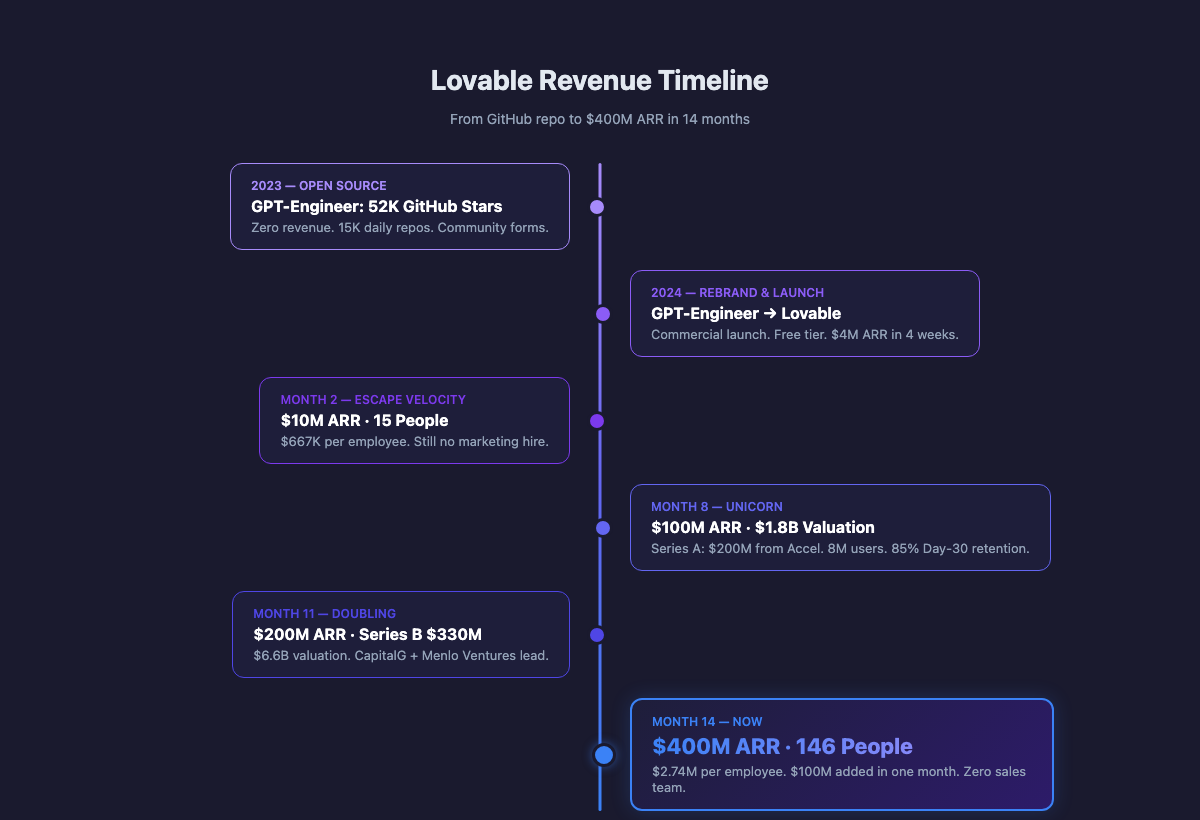
$2.74 million in ARR per employee. That's not five times the SaaS benchmark. That's closer to ten times. And they did it with zero paid advertising and no outbound sales team.
Look, I know these numbers sound made up. They're not. TechCrunch confirmed Lovable added $100M in revenue in a single month (February 2026) with just 146 people. Their Series B closed at a $6.6 billion valuation.
But here's what actually matters: how they got there isn't what you'd expect.
It Started with 52,000 Stars and Zero Revenue
Before Lovable existed, there was GPT-Engineer. An open-source project that Anton Osika — a Swedish AI researcher — pushed to GitHub in mid-2023.
He didn't have a business plan. He didn't have a landing page. He didn't even have a company. He had a repo that could generate code from natural language prompts, and he put it out there.
52,000 GitHub stars. 15,000 new repositories created daily from forks and experiments. A community formed around the project overnight.
Why Open Source Was the Smartest "Marketing" Move
Most founders I've worked with see open source as a threat. "If I give away the code, why would anyone pay?" But Anton understood something they don't: open source doesn't give away value. It creates an audience that already believes in what you're building.
Those 52,000 stars weren't vanity metrics. They were 52,000 people who had already tried the technology, already understood the value proposition, and were already telling their friends about it. When Lovable launched as a paid product months later, it wasn't a cold start. It was a warm reunion.
I've watched hundreds of AI startups launch to crickets because they skipped this step. They went straight to "book a demo" without ever building the kind of trust that makes someone pull out a credit card on day one.
The Community Before the Product
By the time GPT-Engineer had traction, a 34,000-member Discord community had formed. These weren't passive followers. They were filing issues, suggesting features, building things with the tool, and — crucially — creating content about it without being asked.
This is the part most people miss when they study Lovable's growth. The community wasn't a marketing channel. It was the product development loop. Every Discord thread was free user research. Every GitHub issue was a prioritized feature request. The content that came out of it was organic because the value was real.
The Rebrand That Should've Killed Them
In early 2024, Anton made a decision that most advisors would've called insane: he renamed GPT-Engineer to Lovable.
Think about what that means. You have a project with 52,000 GitHub stars, massive SEO equity, and brand recognition in the AI developer community. And you throw all of it away for a name that sounds like a dating app.
The Reasoning That Actually Made Sense
GPT-Engineer was a technical name for technical people. But the product vision was bigger — anyone should be able to build software, not just developers. "Lovable" communicated emotion and accessibility. It also distanced them from OpenAI's trademark concerns around "GPT."
But the real genius was the timing. They rebranded right before launching the commercial product. Old name = free open-source tool. New name = the premium product built on top of it. Clean separation. The open-source community didn't feel betrayed because GPT-Engineer still existed. Lovable was the next chapter.
I'm not going to pretend I would've had the guts to do this. Renaming a project with that much traction goes against every instinct. But it worked because they'd already built enough trust that people followed the founder, not the brand name.
Anton Osika: The CEO Who IS the Marketing Department
Here's a stat that should make every startup marketing team uncomfortable: Anton Osika personally drove more growth for Lovable than any campaign, any PR agency, or any growth hack ever could.
96,900 LinkedIn followers. The #1 tech influencer in Sweden. Posts 2-3 times per week. Never tags the company page. Generates 135,000-202,000 impressions per year organically.
And he didn't hire a marketing person until after $10 million ARR.
What Anton Actually Posts
This is where it gets interesting. Anton's content isn't polished. It's not optimized. It's not what a content strategist would recommend. But it works because it follows a pattern I've seen in every successful founder-led marketing story:
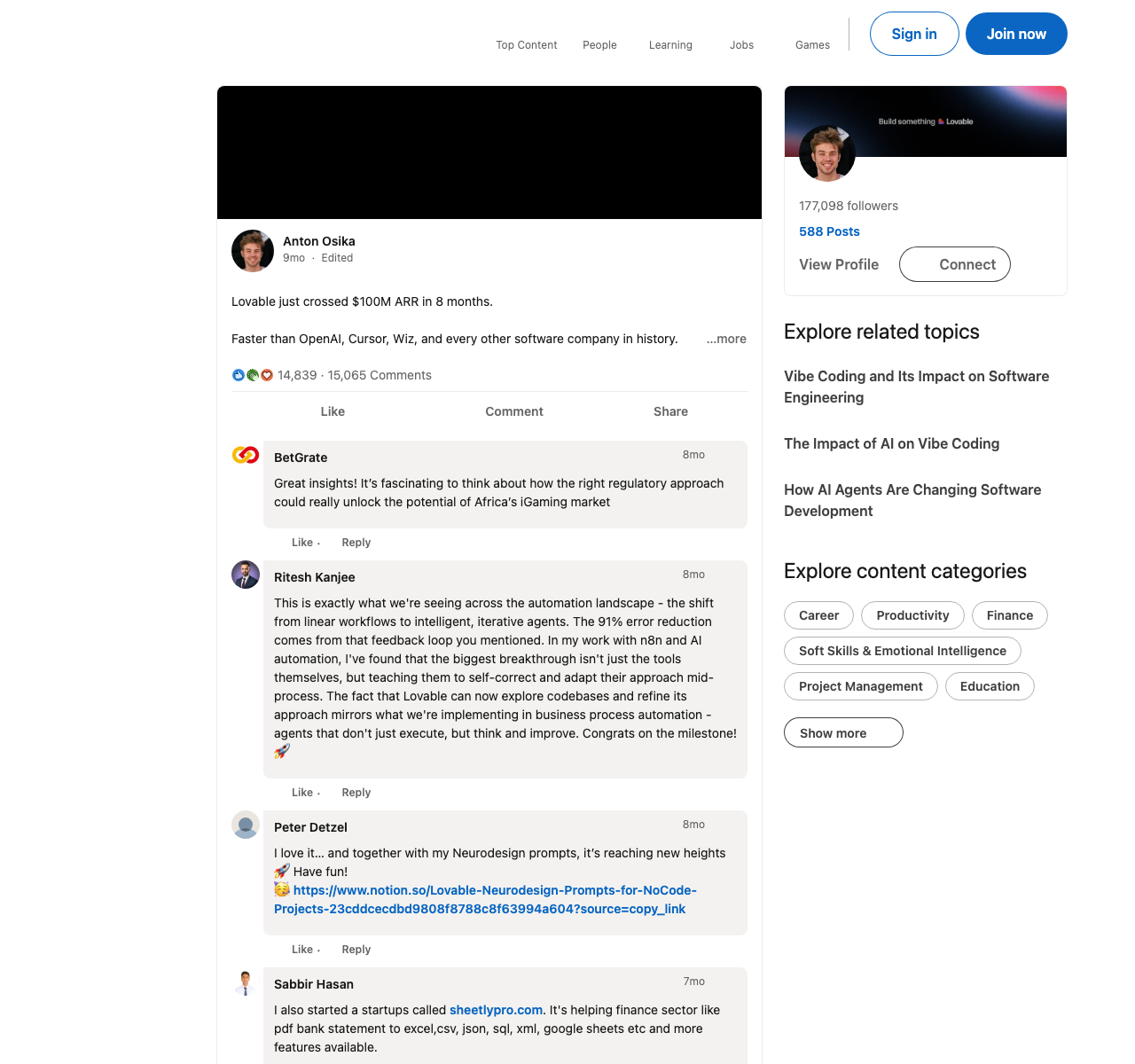
Transparency over perfection. He shares revenue numbers openly. $4M ARR. $10M ARR. $100M ARR. Each milestone gets a post. Not a press release — a personal reflection. "Here's what we learned. Here's what almost broke. Here's what I'd do differently."
Building in public. Hiring updates, product decisions, even doubts. When Lovable hit scaling challenges, Anton talked about them. When they made mistakes, he posted about those too. This isn't a strategy most CEOs would be comfortable with. But it creates the kind of trust that a corporate blog never will.
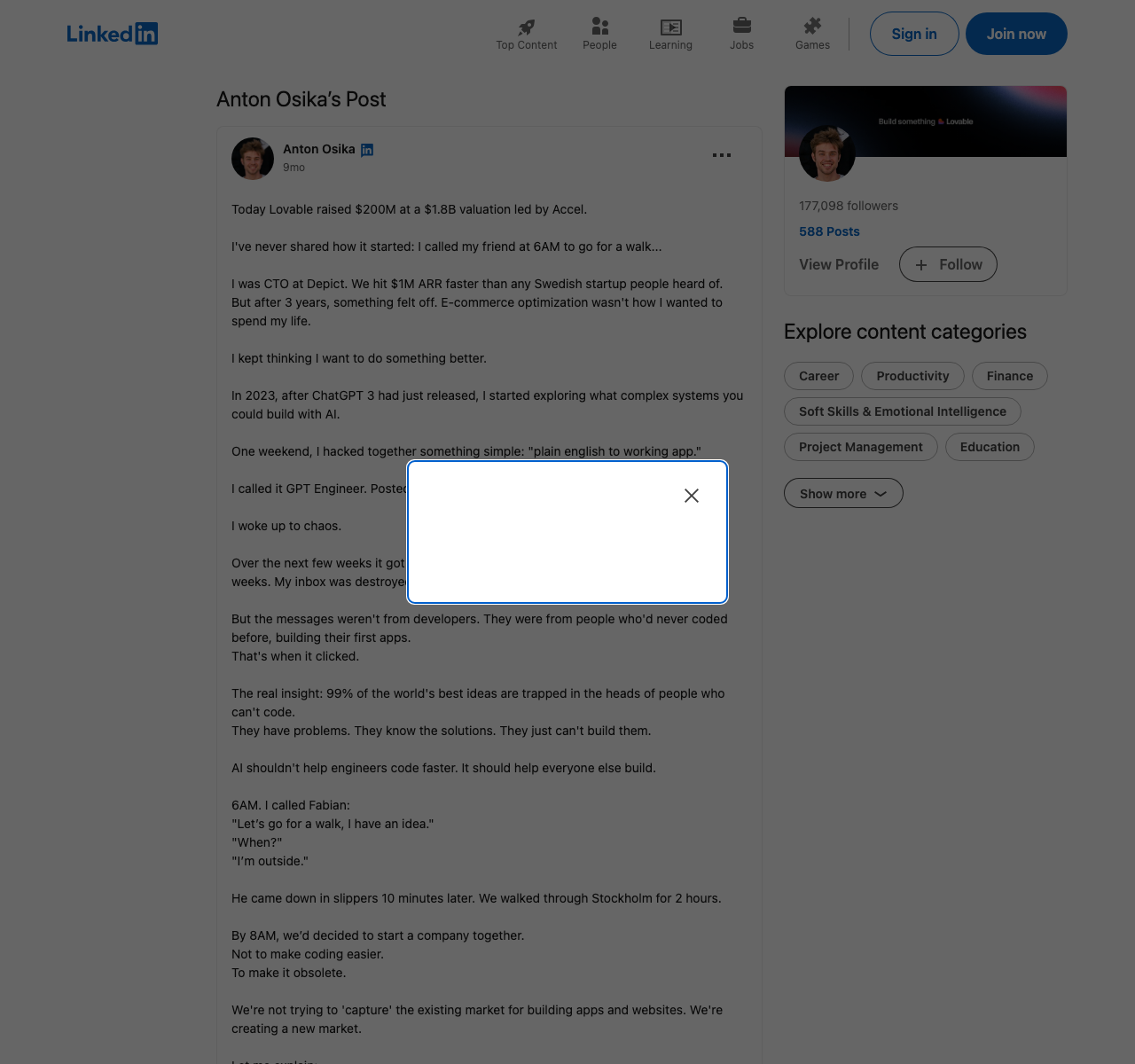
The CEO as product demo. Anton regularly demos Lovable's capabilities directly in his posts. Building an Airbnb clone in 30 seconds. Showing real-time code generation. Each post doubles as both content and proof that the product works.
Why This Works Better Than a Marketing Team
I've spent two decades watching companies hire marketing teams and hand them a product they barely understand. The result is always the same: generic content that sounds like it could be about any product in the category.
Anton doesn't have that problem because he IS the product. When he talks about what Lovable can do, it's not a positioning statement written by a copywriter. It's a founder who built the thing showing you what it does. That authenticity is worth more than any marketing budget. This is exactly why founder-led content consistently outperforms brand content — the audience can tell the difference.
The 4-Layer Content Engine Behind $400M ARR
Lovable's growth didn't come from one channel. It came from four layers that compound on each other. Remove any one layer and the whole thing slows down.
Layer 1: Open Source as the Top of Funnel
GPT-Engineer on GitHub was never monetized directly. It was the awareness engine. 52,000 stars meant 52,000 people who discovered the technology organically, tried it, and formed an opinion before Lovable ever asked for money.
Most SaaS companies spend 40-60% of revenue on sales and marketing to achieve what Lovable got for free from a GitHub repo.
Layer 2: Founder Content as the Trust Layer
Anton's LinkedIn presence converted awareness into trust. People who discovered GPT-Engineer on GitHub would find Anton on LinkedIn, see him sharing real metrics and honest reflections, and start to believe this wasn't just another AI tool — it was a serious company with a serious founder.
Layer 3: Product-Led Growth as the Conversion Engine
Free tier with daily credits. No sales call required. No demo booking. You show up, you try building something, and within 10 minutes you either see the value or you don't. Lovable's 85% Day-30 retention rate tells you most people see the value.
This is the layer that converts trust into revenue. And it works because Layers 1 and 2 already did the hard work of getting the right people in the door.
Layer 4: Community as the Retention and Referral Loop
34,000 Discord members. 100,000+ new projects every day. Users sharing what they built, helping each other debug, suggesting features. Each project creates a new entry point for discovery — someone sees an app, asks "how did you build this?", and the answer is always "Lovable."
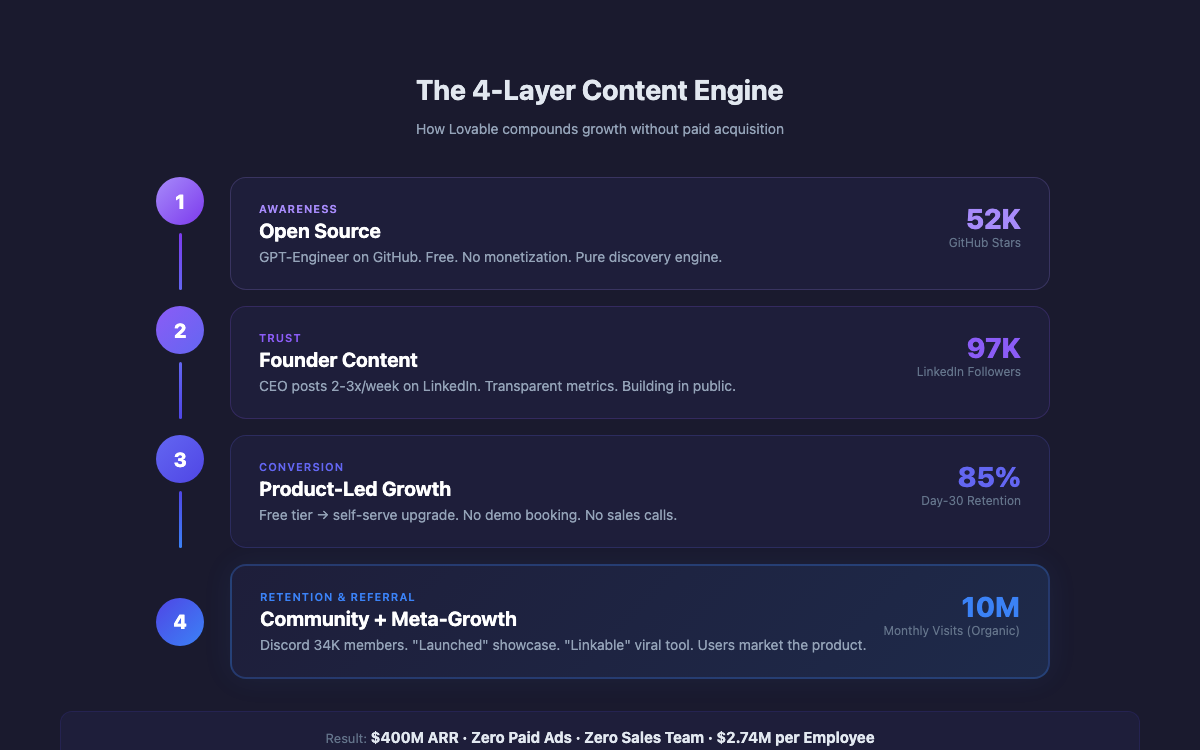
10 million monthly visits. Almost entirely organic. That's the power of four layers working together.
"Meta-Growth": When Your Product Markets Itself
This is the part of Lovable's strategy that genuinely blew my mind.
They built marketing tools using their own product. Not as a side project. As a core growth strategy.
Launched: A Product Hunt Inside Lovable
Lovable created "Launched" — a platform where users can showcase apps they've built with Lovable. Think Product Hunt, but exclusively for Lovable-built products. Every showcased app is a proof point. Every showcase page drives traffic back to Lovable's main site.
It's a showcase, a testimonial, and an acquisition channel rolled into one. And it cost them almost nothing to build because they built it with their own tool.
Linkable: 20,000 Websites from One Tweet
Then there's "Linkable" — a tool that generates personal websites instantly. Anton posted about it once on Twitter. 20,000 new websites created in a week. Every single one had an "Edit with Lovable" button.
Read that again. One tweet. 20,000 new websites. Each one is a free billboard for Lovable. The user gets a personal website. Lovable gets 20,000 new organic backlinks and discovery surfaces.
This is what I mean by "meta-growth." They didn't hire an agency to make ads about their product. They used their product to make tools that market themselves. It's the most capital-efficient growth strategy I've ever seen.
$1 Million Per Employee — Why No Sales Team Is the Point
Lovable generates approximately $2.74 million in ARR per employee. The industry benchmark for a SaaS company at their revenue scale is roughly $200K-400K per employee. They're running at 7-10x the norm.
And the reason is simple: they never built a sales team.
The Math That Changes Everything
A typical B2B SaaS company with $400M ARR would have 80-150 salespeople, each costing $150K-250K fully loaded. That's $12M-$37M per year in sales compensation alone. Add SDRs, sales engineers, and management, and you're looking at $30M-$60M annually.
Lovable spent exactly $0 on outbound sales. They took that money and invested it in product and engineering — which made the product better, which drove more organic growth, which made the product even better.
This is the flywheel that most companies never build because they're too busy hiring salespeople after their Series A.
Traditional SaaS at $400M ARR
- 500-800 employees
- 80-150 person sales team
- $30-60M annual sales cost
- 40-60% revenue spent on S&M
- $500K-800K ARR per employee
- 18-24 month payback period
Lovable at $400M ARR
- 146 employees
- Zero sales team
- $0 outbound sales cost
- Near-zero paid acquisition
- $2.74M ARR per employee
- Instant payback (self-serve)
The Retention Secret Most AI Tools Would Kill For
85% Day-30 retention. Let that number sink in.
ChatGPT — the most talked-about AI product in history — has lower retention than Lovable. Most AI tools see 20-40% Day-30 retention because users try them once, think "cool," and never come back.
Why Lovable Users Stay
The difference is output permanence. When you use ChatGPT, you get text. It's useful, but it doesn't compound. When you use Lovable, you get a working app. That app has users, data, and ongoing value. You can't just walk away from it.
Every project a user builds creates switching costs. Not artificial lock-in — genuine value that makes leaving irrational. Your app is running. Your users are using it. Why would you rebuild it somewhere else?
This is the fundamental insight most AI products miss. They optimize for "wow" moments. Lovable optimizes for "I can't live without this" moments. Those are very different things.
What Most AI Startups Get Wrong About Content
I work with AI founders every day. And I see the same three mistakes over and over.
Mistake 1: Treating Content as a Campaign
"Let's do a content push for launch." That's not a strategy. That's a panic response. Lovable's content engine works because it's been running since before the product existed. The GitHub repo, Anton's LinkedIn, the Discord community — these were all producing content and building trust for months before anyone was asked to pay.
Mistake 2: Hiring an Agency Before Having a Voice
I've said this before and I'll keep saying it: agencies can amplify your voice. They cannot create it. If you haven't figured out what you stand for, what your contrarian takes are, and why anyone should listen to you specifically — an agency will just produce expensive noise.
Anton didn't hire marketing help until after $10M ARR. By that point, the voice was established. The content strategy was proven. A marketing hire could amplify what already worked instead of guessing from scratch.
Mistake 3: Building the Product in a Black Box
Most startups build in secret, launch with a bang, and wonder why nobody cares. Lovable built in public for over a year. By launch day, 52,000 people were already invested in the outcome.
Building in public isn't about giving away secrets. It's about creating a group of people who feel ownership over your success. When Lovable hit $100M ARR, those early GitHub contributors celebrated like it was their win too. Because in a way, it was.
How to Apply This Even If You're Not Lovable
Not every startup can be Lovable. They had an exceptional product in an exploding market with a founder who happened to be naturally good at public communication. But the framework is repeatable.
Start With a Free Asset
You don't need 52,000 GitHub stars. You need one free resource that demonstrates your expertise and creates genuine value. A template, a tool, a framework, a dataset. Something people use, share, and come back to. This becomes your Layer 1 — the awareness engine that runs on its own.
Let the Founder Be the Voice (at Least Initially)
For the first $1-10M in revenue, nobody tells your story better than you. Post 2-3 times a week on LinkedIn. Share what you're building, what's working, what isn't. You don't need to be a great writer. You need to be honest about a journey that people can relate to.
If creating consistent content feels impossible alongside running a company, systems exist to help. Runnax, for example, takes your expertise and produces on-brand content daily — the kind of thing that would've taken Anton's team weeks to systematize manually.
Build Your Community Before You Need It
Discord, Slack, GitHub Discussions — pick one. Start collecting your early users in a place where they can talk to each other, not just to you. The magic happens when users start helping other users. That's when your community becomes self-sustaining.
Use Your Product to Market Your Product
Lovable built "Launched" and "Linkable" using Lovable itself. What can you build with your own product that creates viral distribution? A free tool that embeds your brand? A showcase for user creations? Think about what your customers would use and share even if they weren't paying you.
See How Runnax Automates Your Content Engine →
FAQ
How did Lovable grow so fast without paid advertising?
Lovable's growth came from four compounding layers: open source awareness (52K GitHub stars), founder-led content (Anton Osika's LinkedIn with 97K followers), product-led growth (free tier with daily credits and 85% Day-30 retention), and community-driven referrals (34K Discord members, 10M organic monthly visits). Each layer fed the others, creating a self-reinforcing growth loop that eliminated the need for paid acquisition.
What is "vibe coding" and why does it matter for content marketing?
Vibe coding refers to building software by describing what you want in natural language rather than writing code manually. Lovable pioneered this category, and their content strategy helped define the term. For content marketing, it matters because Lovable's approach shows how creating and owning a category term generates organic search traffic and positions you as the default authority.
Can founder-led content really replace a sales team?
In Lovable's case, yes. Anton Osika's personal LinkedIn content, combined with product-led growth mechanics, replaced what would typically require 80-150 salespeople at their revenue scale ($400M ARR). However, this works best with self-serve products where the buyer can experience value independently. B2B products requiring complex implementation may still need some sales support, though founder content can dramatically reduce the team size needed.
What was Lovable's revenue growth timeline?
Lovable grew from $0 to $400M ARR in approximately 14 months: $4M ARR (week 4), $10M ARR (month 2), $17M ARR (month 3), $50M ARR (month 5), $100M ARR (month 8), $200M ARR (month 11), and $400M ARR (month 14). At peak velocity, they were adding $2M in new ARR weekly. The company reached $6.6B valuation with just 146 employees.
How can an AI startup replicate Lovable's content strategy?
Start with three actions: (1) Create one free resource that demonstrates your core technology — a tool, template, or open-source project that people will share organically. (2) Commit the founder to posting 2-3 times weekly on LinkedIn with honest, transparent updates about the company's journey. (3) Build a community space (Discord or Slack) before you need it, and invest in making early users successful. The key insight from Lovable is that content should start before the product launches, not after.
Related Reading
- Founder-Led Marketing: What It Is and Why It Outperforms Traditional B2B Demand Gen
- How Clay Went from $1M to $100M ARR Using Content Instead of Ads
- From Zero to Trusted Expert: A 90-Day Founder Content Plan
Sources
- TechCrunch: Lovable added $100M in revenue in one month with 146 employees
- TechCrunch: Lovable raises $330M at $6.6B valuation
- Lenny's Newsletter: Building Lovable — $10M ARR in 60 days with 15 people
- Lovable Blog: Series B announcement
- AI Native GTM: How Lovable reached $75M ARR in 7 months
- Sacra: Lovable revenue, funding & growth data
- Panto: Lovable Statistics 2026 — Users, Revenue & Adoption