
By Kyan Gao, Co-Founder of Runnax. 20 years in B2B content growth. Built a 1M+ audience as a founder creating content firsthand. Helped 200+ founders go from invisible to recognized industry voice.
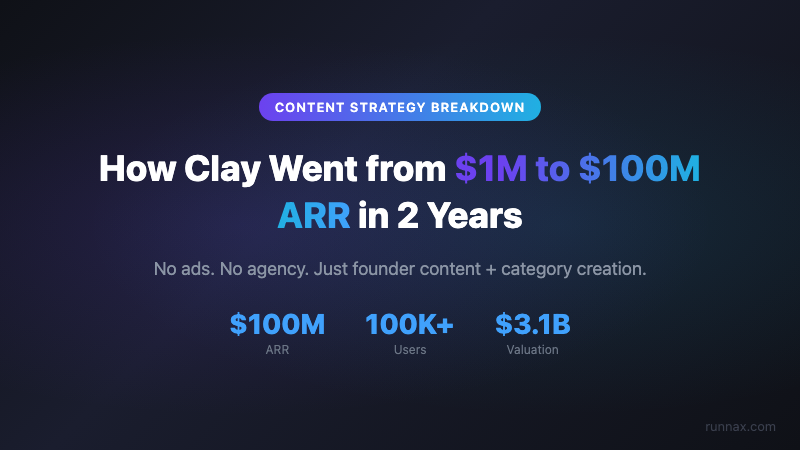
I've worked with over 200 founders on their content. The ones who fail fastest all start the same way — hire an agency, run some ads, wait for leads. Clay did the opposite. They went from $1M to $100M ARR in two years, with no paid ads, no content agency, and no traditional demand gen.
If you're an AI or SaaS founder who's tried agencies, burned budget on channels that didn't work, or simply can't find the time to post consistently — this breakdown is for you. I'm going to walk through exactly what Clay did, what most people get wrong about their story, and what you can actually take from it.
What Clay Does
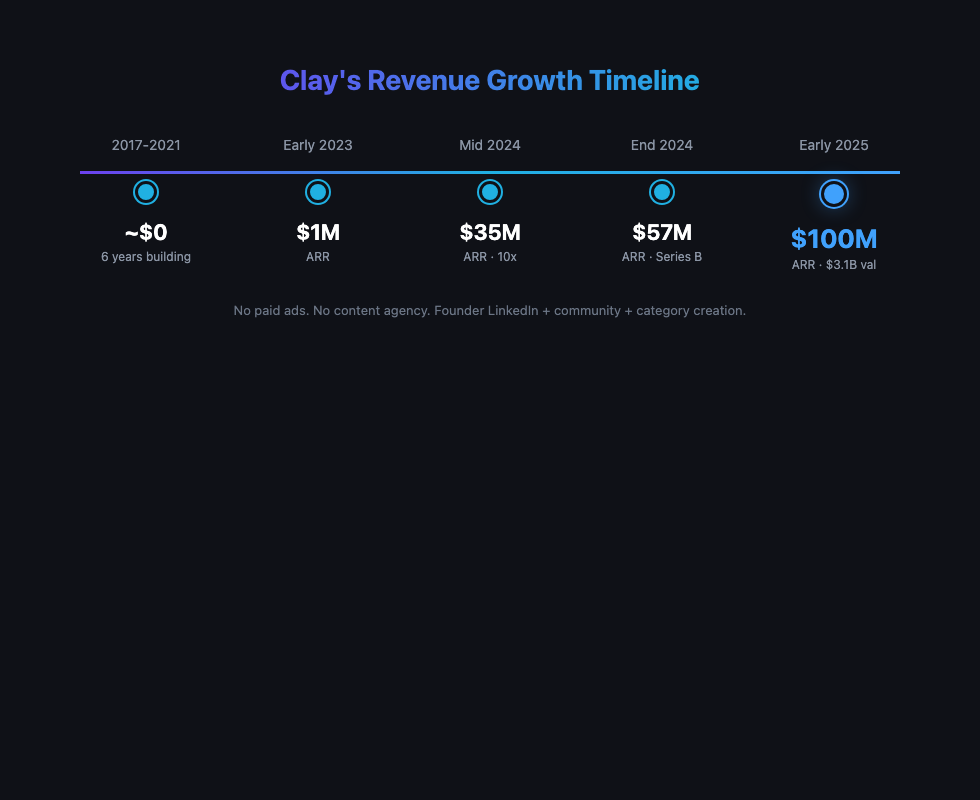
Clay is a B2B data enrichment and outbound automation platform. Founded in 2017 by Kareem Amin and Nicolae Rusan, the company spent six years quietly building with near-zero revenue. Then something changed. By early 2023, Clay hit $1M ARR. By early 2025: $100M ARR, a $3.1B valuation, and over 100K users.
The thing that changed wasn't a new feature or a funding round. It was a content strategy — and it's one that most marketing teams would never even consider running.
The Strategy: Create a Job Title, Not a Campaign
Clay didn't run ads. They didn't hire a content agency. Instead, they did something I've never seen another B2B company pull off at this scale: they invented a profession.
The term "GTM Engineer" didn't exist before Clay. They coined it to describe a new type of practitioner — someone who builds automated data pipelines, enrichment workflows, and outreach sequences for go-to-market teams. As Clay put it in their manifesto: "Your GTM motion isn't under-staffed — it's under-engineered."
By naming this role and building a community around it, Clay turned their users into their marketing department. Every GTM Engineer who shared a Clay workflow on LinkedIn was essentially doing free product marketing. Every case study a practitioner published was organic demand gen that Clay didn't pay a dollar for.
The scale of this is worth pausing on:
- 100+ GTM Engineer job listings appear on LinkedIn every month
- 40+ independent "Clay Experts" have built consulting careers around the platform
- 60+ Clay Clubs host events globally
- "Claygencies" — agencies specializing in Clay implementations — have emerged as an entirely new business category
- Someone is now pursuing a PhD in GTM Engineering
The identity grew independently of Clay's marketing budget. Practitioners formed communities, shared playbooks publicly, and identified professionally as GTM Engineers — with Clay as the default platform. (Source: nrich.io)
I've helped hundreds of founders build their content presence, and this is the single most effective strategy I've ever studied. Most companies try to create content that talks about their product. Clay created an identity that made people want to talk about their product for them.
What the Founder Actually Did: Kareem Amin's LinkedIn Playbook
Kareem Amin's LinkedIn presence was the anchor of Clay's entire growth strategy. But he wasn't posting "5 tips for better outbound." He ran a specific, repeatable playbook with four distinct post types — and this is where it gets interesting for any founder trying to build a content presence.
Post Type 1: Operating Principles
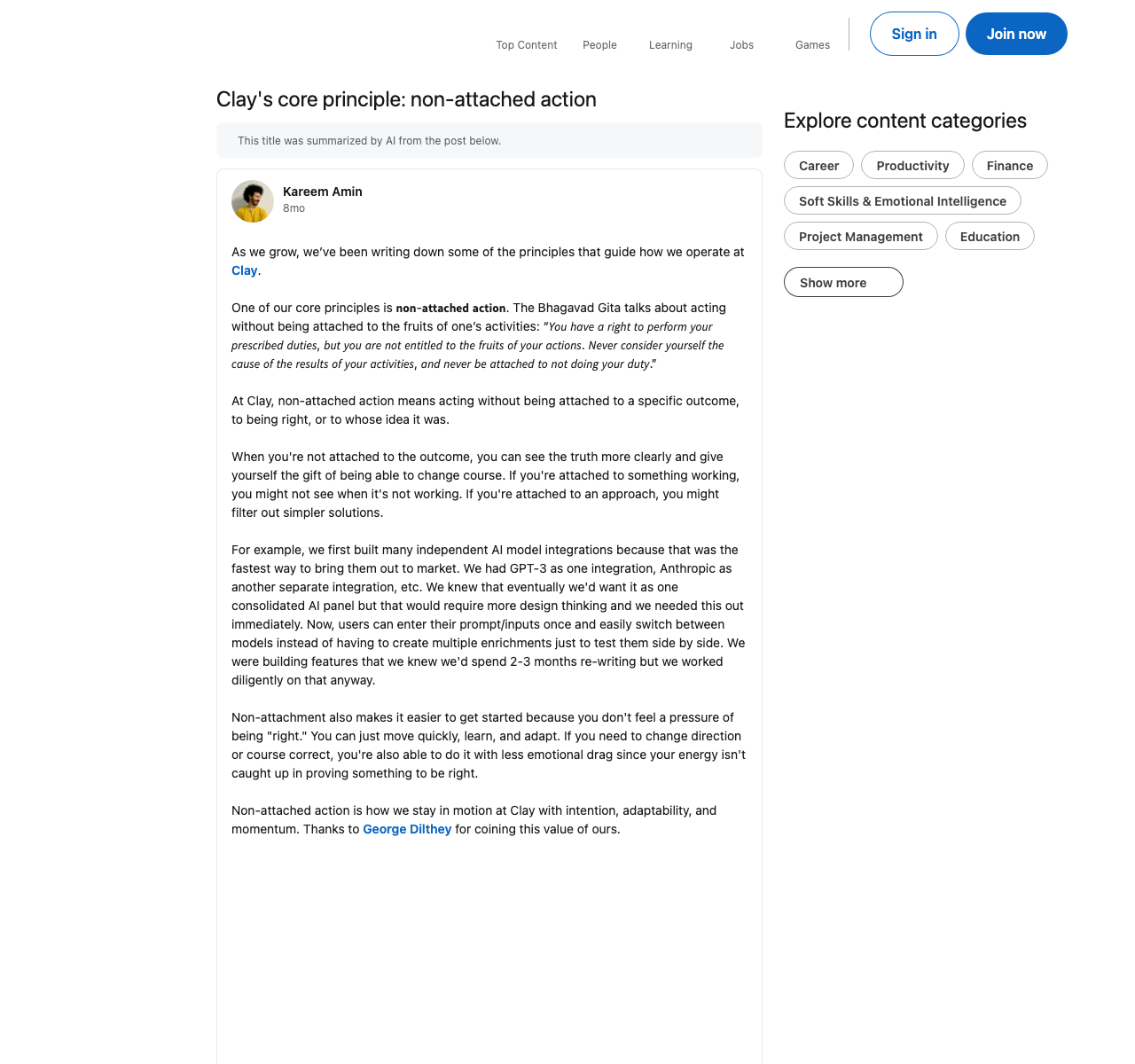
Kareem regularly shared how Clay makes internal decisions. One post about "non-attached action" explained Clay's sprint discipline: "Once we agree to something and it's in our sprint planning, nothing will shift it. If you're walking to work and you happen to have a new idea, throw it away."
This is the kind of post that filters your audience. Casual readers scroll past. But operators who think the same way — exactly Clay's ICP — stop and engage. That's the point.
Post Type 2: Customer Impact Stories
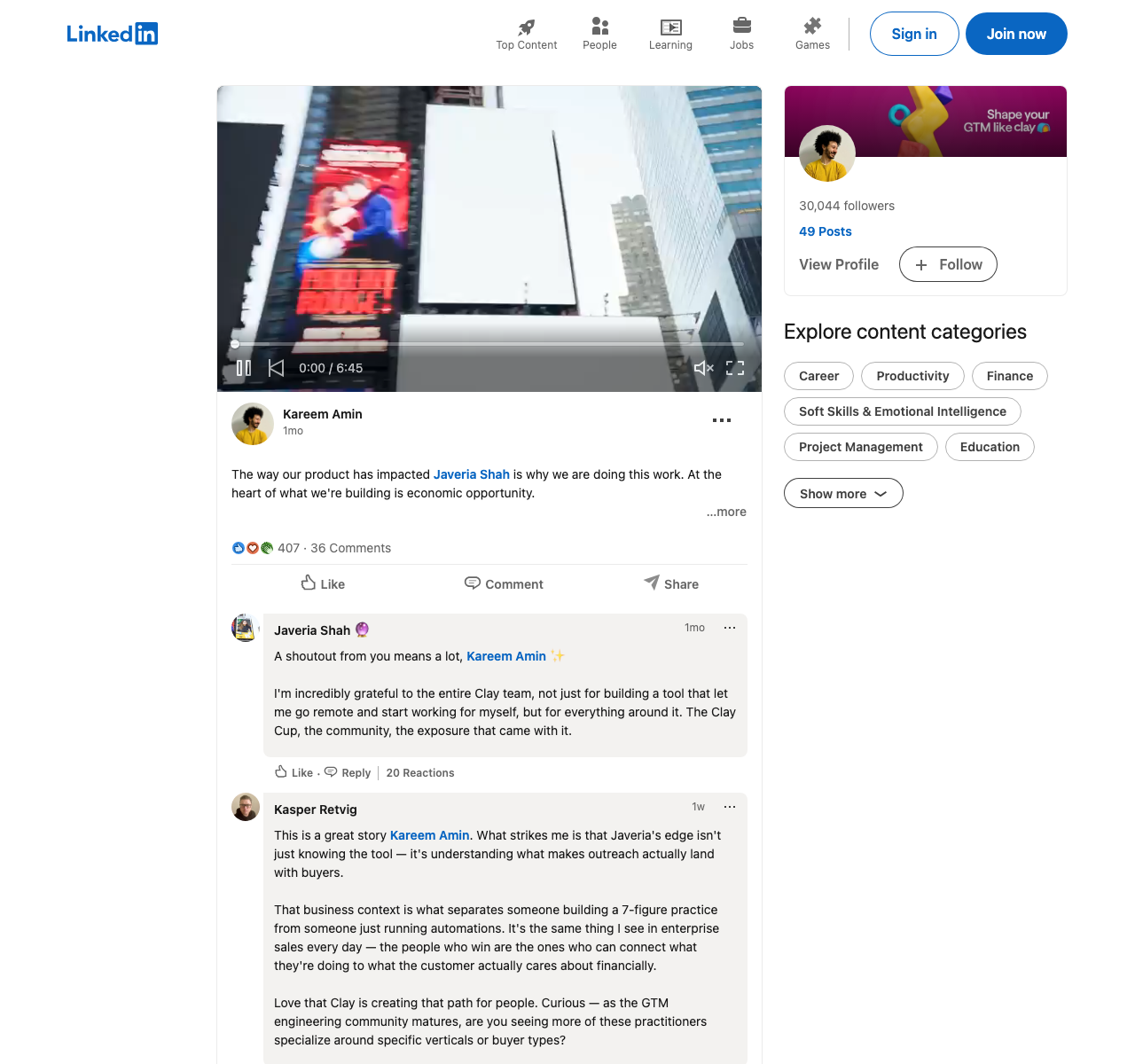
Instead of generic testimonials, Kareem shared specific user journeys. One that stood out: Javeria Shah, who won the first Clay Cup from Karachi, Pakistan, turned down a $150K job offer at 26, and built a 7-figure GTM Engineering business with her husband — all using skills she developed on Clay.
These aren't just case studies. They make the GTM Engineer identity aspirational. That's a very different thing.
Post Type 3: Milestone Posts with Product Thinking
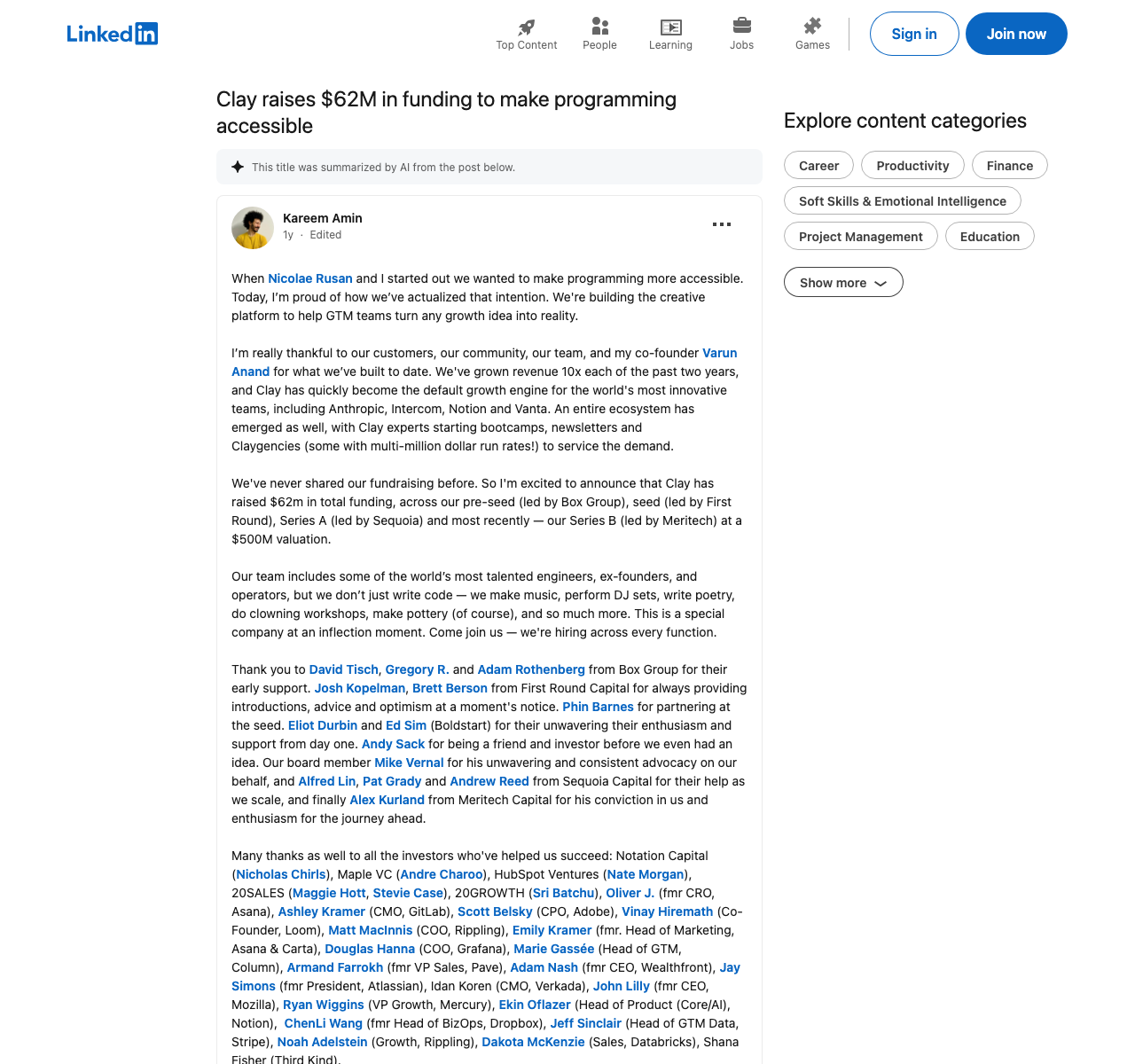
When Clay raised $62M or announced their $1.25B valuation, Kareem didn't just celebrate. He explained the why behind the numbers — the product vision, the team decisions, the market shift they were betting on. Every milestone post doubled as category education.
Post Type 4: Product Strategy with Proof
Kareem shared specific results: Clay's growth team used their own product to drop LinkedIn CPL from $250 to $25 through auto-synced exclusion lists. This wasn't a case study PDF — it was a LinkedIn post showing real numbers from their own usage.
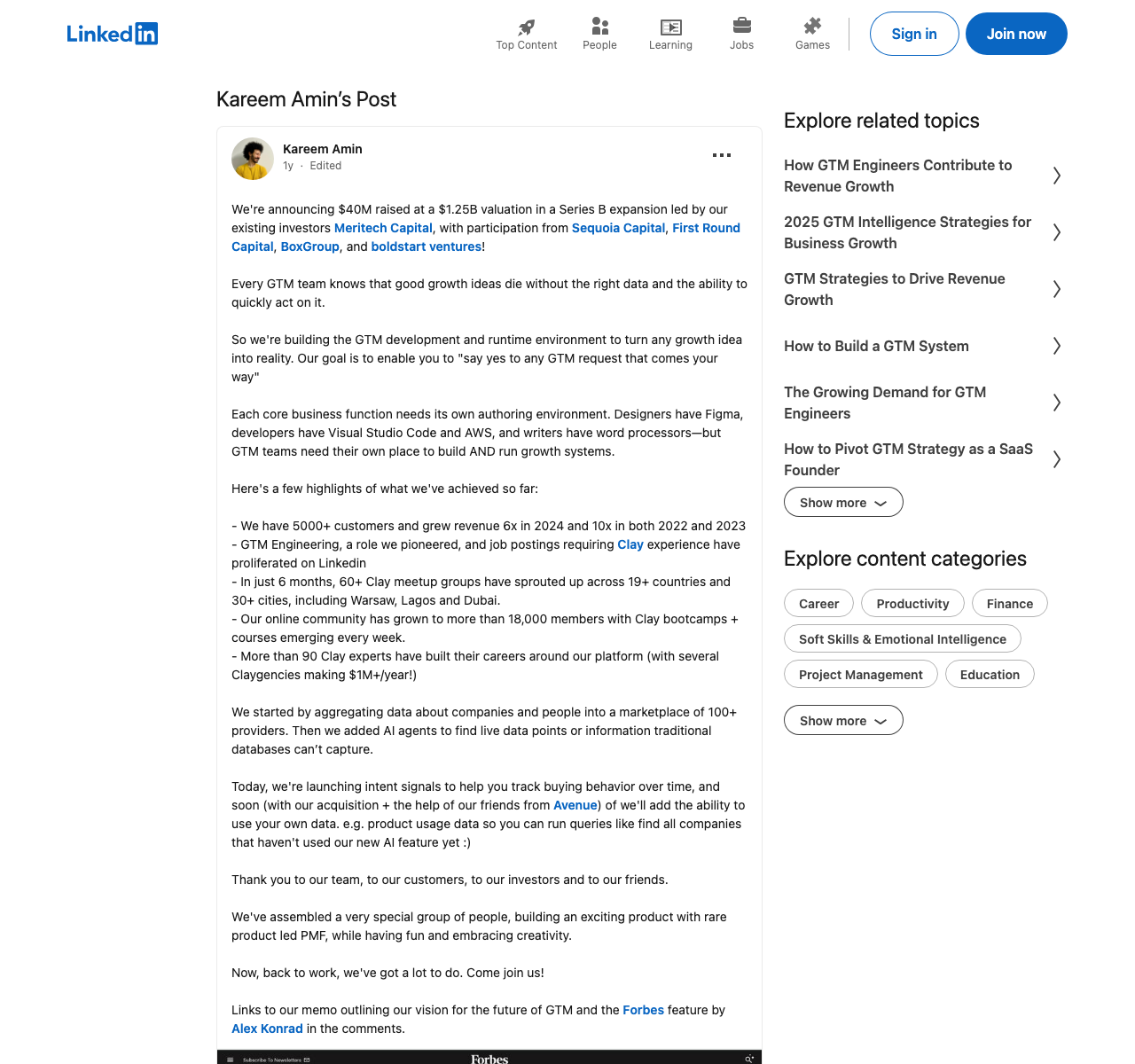
The pattern across all four types: Kareem never posted as "Clay CEO selling a product." He posted as a practitioner thinking out loud about how go-to-market is changing. That framing made every post feel like insight instead of promotion. (Source: First Round Review)
I see this mistake constantly with the founders I work with. They default to talking about features. The founders who build real audiences talk about decisions — why they built what they built, what they chose not to build, what surprised them. That's what people actually want to follow.
How Clay Built a Community Flywheel: From 200 to 11,000 Members
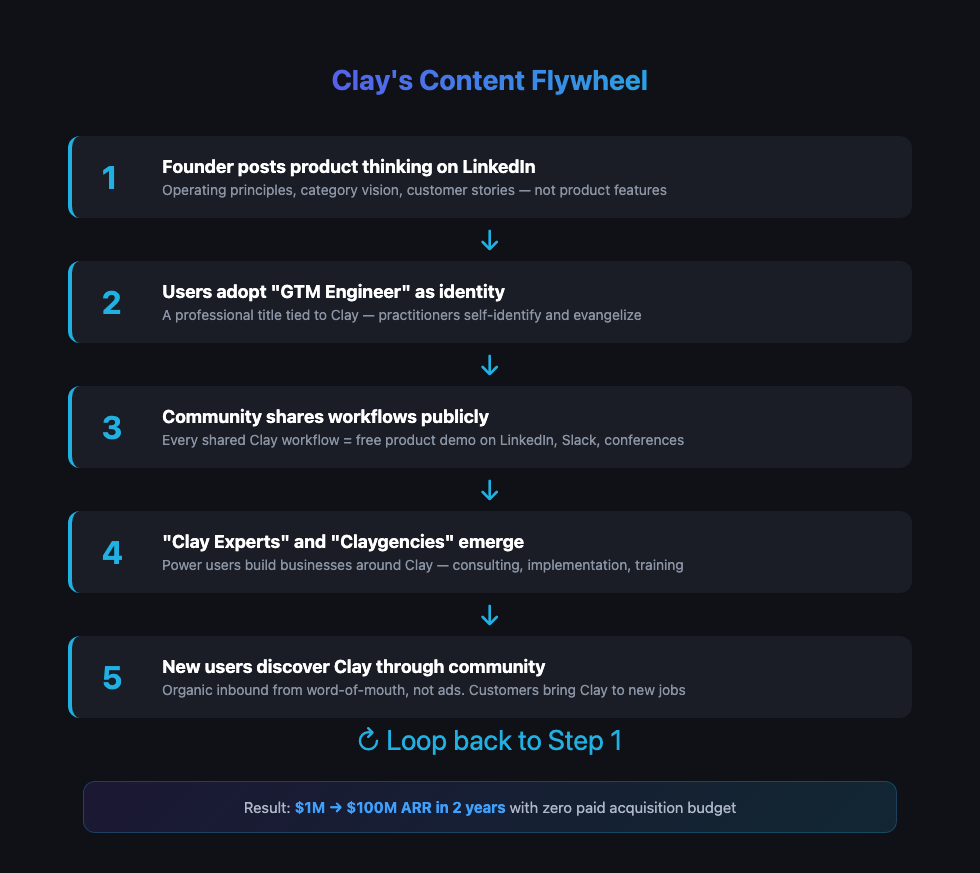
Clay's community didn't happen by accident. It followed a deliberate four-step playbook, and the order matters.
Step 1: Infiltrate Existing Communities First
Before building their own community, Clay's team embedded themselves where their ICP already hung out: Modern Sales Pros, SaaS Yacht Club, Sales Technicians Slack groups. They used a tool called Syften to set keyword alerts — whenever someone mentioned outbound automation, data enrichment, or related topics, Clay responded immediately with genuine help. Not sales pitches. Actual help.
Step 2: Make Community a Core Business Function
Clay's third business hire was Eric Nowoslawski, a community champion known as "the king of the WhatsApp groups." Not someone you'd expect as hire number three. Not an engineer, not a salesperson — a community person. That tells you how seriously they treated this from day one. (Source: First Round Review)
Step 3: Force Community Joining
This was the boldest move.
Clay removed Intercom — their traditional customer support tool — and mandated that users join the Slack community to get help. Most companies would never do this. But instead of isolated 1:1 support tickets, every question became visible to the community. Users helped users. Solutions became shared knowledge. The Slack grew from 200 to over 11,000 members.
Step 4: Let the Community Become the Sales Force
As the community scaled, three things happened organically:
- Users shared workflows publicly — on LinkedIn, in Slack, at conferences. Every shared workflow was a live product demo that Clay didn't pay for.
- "Clay Experts" emerged — practitioners who built consulting businesses around Clay implementations.
- Customers brought Clay to new jobs — when GTM Engineers switched companies, they brought Clay with them. Built-in expansion with zero sales effort.
In September 2024, Clay held Sculpt — their first conference in San Francisco with 300+ GTM operators. The event generated case studies, testimonials, and community identity that no competitor could replicate by outspending them. (Source: nrich.io)
This flywheel is exactly how we think about founder-led content at Runnax. The founders who post consistently for 90 days build a compounding audience that starts working for them. The hard part isn't the strategy — it's getting to day 90 without burning out.
The Content Cascade: How Clay Turned Posts into a Content Engine
Clay's content team described their process as a loop: "Every conversation turns into product feedback, every conversation turns into content." In practice, it works like this:
- LinkedIn posts — Kareem and team test ideas as short-form posts
- Top performers become blog posts — expanded with data and examples
- Blog posts become guides — comprehensive resources like "The Rise of the GTM Engineer"
- Guides generate community discussion — which feeds new LinkedIn post ideas
Clay never had to guess what content to create. The community told them what resonated, and they expanded on it.
This cascade — test short, expand the winners, loop the learnings back — is the same structure we use at Runnax when building content systems for founders. The difference is we automate the testing and expansion process, so the founder's job is just to review what the system produces.
The Timing Factor Nobody Talks About
Most Clay breakdowns focus on the community tactics and the GTM Engineer concept. What they miss is why it worked when it worked.
Clay spent six years at near-zero revenue. They didn't just build a product — they waited for the market to catch up. Three shifts converged in 2022-2023:
- AI tools made data enrichment accessible. Before GPT-3 and the LLM wave, building enrichment workflows required serious technical chops. AI lowered the barrier, expanding Clay's addressable market overnight.
- Remote work made outbound automation essential. Sales teams couldn't rely on in-person networking anymore. Automated outbound went from "nice to have" to "survival tool."
- LinkedIn's algorithm shifted. In 2023, LinkedIn started heavily rewarding long-form practitioner content over corporate posts. Kareem's post style — founder thinking out loud — was exactly what the algorithm wanted to surface.
Clay's "overnight success" was actually a six-year bet on market timing. The content strategy was the ignition — but the fuel was already there.
I think this is the most underappreciated part of their story. Tactics without timing give you mediocre results. Most founders I work with don't have six years to wait. Which means the content execution has to be faster and more consistent to compensate.
| Metric | Before Content Strategy (2022) | After (2025) |
|---|---|---|
| ARR | ~$1M | $100M |
| Slack Community | 200 members | 11,000+ |
| "GTM Engineer" Job Listings | 0 | 100+/month |
| Paid Advertising Spend | $0 | $0 |
| Independent Clay Experts | 0 | 40+ |
| Valuation | Undisclosed | $3.1B |
Two More Tactics Most People Miss
The 15-Month Waitlist
While growing through millions in ARR, Clay maintained a 15-month waitlist. They deliberately limited access to maintain product quality and community signal-to-noise ratio. This created scarcity, but more importantly, it ensured that early users were genuinely invested — and became the strongest evangelists.
Honestly, I'm not sure most early-stage founders can afford to wait 15 months. But the underlying principle is sound: your first 100 users matter more than your first 10,000 impressions.
The Reverse Demo
Clay abandoned traditional scripted product demos. Instead, they ran "reverse demos" — 30-minute sessions where the prospect brings their real data problem, and Clay's team solves it live. Every reverse demo produced an immediate workflow the prospect could use.
This is the part that surprised me most when I dug into their story. Most SaaS companies spend months perfecting a demo script. Clay threw the script away and let the prospect's actual problem drive the conversation. The close rate was dramatically higher because the prospect left with something they could use that day.
What Made It Work (The Non-Obvious Parts)
1. They didn't scale content. They scaled identity. Most companies try to publish more blog posts. Clay created a professional identity. When someone calls themselves a "GTM Engineer," they're implicitly endorsing Clay. The content created itself because practitioners wanted to share their work.
2. The founder was the category anchor, not the brand. Kareem posted as a practitioner, not a CEO. That framing is everything. The moment your content feels like a sales pitch, the algorithm buries it and the audience tunes out.
3. Product architecture enabled sharing. Clay's workflow-based product is inherently visual and specific. When a user builds a workflow, other people can look at it and immediately understand what it does. Not every product has this advantage — but every product has some shareable artifact. You just have to find it.
What You Can Actually Use
Not everything Clay did is replicable. They had six years of runway, a perfectly timed market shift, and a product that's inherently visual. But some things translate directly:
1. Name the problem your users have — as an identity. Clay didn't say "use our tool for outbound." They said "you're a GTM Engineer." If you're a technical founder who hates marketing language, this approach works even better — because you're naming what practitioners actually do, not what marketers think they should care about.
2. Share your product decisions, not your product features. Kareem's best-performing posts were explanations of why Clay makes certain decisions. If you're pre-product-market-fit, this is the highest-leverage content you can create — because every decision post doubles as customer discovery.
3. Make your product shareable by design. If users can't easily show others what they built with your product, you're leaving organic growth on the table. Clay workflows are visual and specific. If your product isn't inherently visual, create artifacts that are — dashboards, reports, templates, before/after comparisons.
4. Start the community before you need it. Clay's Slack started with 200 people. It took years to reach 11K. If you're pre-revenue, start with three existing communities where your ICP already hangs out. Add genuine value for 90 days before building your own space.
The Runnax Perspective
Clay's story validates a core belief behind Runnax: the founder's voice is the most powerful growth asset a company has. Kareem Amin didn't outsource his LinkedIn to an agency. He showed up personally, shared real thinking, and built a category around it.
But here's what I keep running into with the founders I work with: they know this. They've read the Clay case study. They agree founder-led content is the move. And then Monday comes, they have a product to build, a team to manage, investors to update — and the LinkedIn post doesn't get written. Week after week.
That's the gap Runnax was built to close. Not the strategy gap — the execution gap.
What this actually looks like: A founder signs up, inputs their website URL. Within 48 hours, Runnax analyzes top-performing content in their industry, generates a week of scripts in their voice, and produces AI avatar videos and LinkedIn articles ready for review. One approval click, and it publishes directly to TikTok and LinkedIn.
Without a content system
- Research competitors: 3 hours
- Write 1 post: 2 hours
- Record video: 1 hour
- Edit + publish: 1 hour
- = 7 hours per piece of content
With Runnax
- Review AI-generated script: 10 min
- Approve or edit: 5 min
- Auto-publish to TikTok + LinkedIn
- = 15 minutes per piece of content
Clay proved the model works. Runnax makes it possible for founders who don't have six years and a dedicated community team.
See how it works — Start free demo
Frequently Asked Questions
How did Clay grow from $1M to $100M ARR without paid ads?
Clay grew primarily through founder-led content on LinkedIn, community building (a Slack that grew from 200 to 11,000+ members), and creating the "GTM Engineer" professional identity. Their users became their marketing department by sharing Clay workflows publicly and identifying professionally with the role Clay defined.
What is a GTM Engineer?
A GTM Engineer is a term coined by Clay to describe practitioners who build automated data pipelines, enrichment workflows, and outreach sequences for go-to-market teams. The role combines sales operations, data engineering, and growth marketing. Over 100 companies now list "GTM Engineer" as a job title on LinkedIn.
What content strategy did Clay's founder use on LinkedIn?
Kareem Amin used four distinct post types: operating principles (how Clay makes internal decisions), customer impact stories (specific user journeys), milestone posts with product thinking (explaining the "why" behind funding rounds), and product strategy with proof (sharing real metrics from Clay's own usage). He posted as a practitioner, not as a CEO selling a product.
Can founder-led content work for early-stage startups?
Yes, but with caveats. Clay had six years of runway and a perfectly timed market shift. Early-stage founders typically need to move faster and post more consistently. The core principles — sharing product decisions, building in public, starting small community presence — work at any stage. The challenge is execution bandwidth, which is why tools that automate content production are increasingly important for resource-constrained founding teams.
How is Clay's founder-led growth strategy different from traditional B2B marketing?
Traditional B2B marketing focuses on brand awareness through ads, SEO, and content marketing managed by a marketing team. Clay's approach centered on the founder's personal voice, community-driven distribution, and identity creation rather than demand generation. The key difference: Clay's "marketing" was done by users who identified as GTM Engineers and shared their work voluntarily.
Related reading:
- Founder-Led Marketing: What It Is and Why It Outperforms Traditional B2B Demand Gen
- From Zero to Trusted Expert: A 90-Day Founder Content Plan
- How AI Can Generate a Month of On-Brand Founder Content Without Sounding Robotic
Sources: First Round Review, First Round Review (GTM Inflection Points), nrich.io, Sacra, Clay Blog