
For B2B founders, the content marketing equation has always felt broken: you know content drives pipeline, but producing it consistently — especially video — requires resources most growing companies simply don’t have. In 2026, AI is fundamentally changing this calculus.
This isn’t about replacing your marketing team. It’s about giving a lean team the leverage to produce content at a scale that was previously impossible without a full production department.
The B2B Content Gap Is Real — And Growing
According to recent industry data, 73% of B2B buyers consume video content during their purchase journey, yet only 29% of B2B companies produce video regularly. The gap between what buyers want and what companies deliver is widening every quarter.
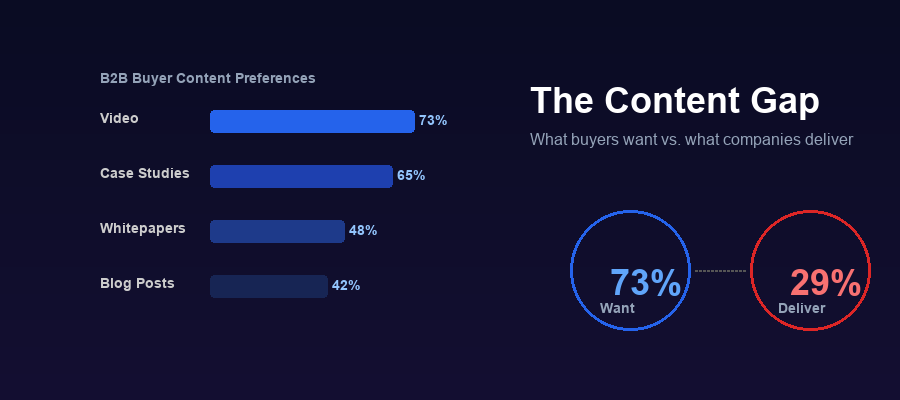
For SaaS founders and AI company leaders, this gap represents both a challenge and an opportunity. Your competitors are likely struggling with the same bottleneck: the distance between knowing what content to create and actually shipping it.
Why Traditional Content Production Fails at Scale
The traditional B2B content workflow looks something like this:
- Strategy: A marketing lead (or founder) decides on topics based on intuition
- Scripting: Someone writes a script or outline — often weeks later
- Production: Video requires scheduling, filming, editing — another weeks-long cycle
- Publishing: Manual uploads to each platform with different format requirements
- Analysis: Maybe someone checks analytics next month
Each step introduces delay. The total cycle time from idea to published content is often 4-6 weeks. By then, the market has moved on.
The AI-Powered Content Engine: A New Approach
What if the entire cycle — from strategy to published, platform-optimized content — could happen in days instead of weeks? That’s the promise of AI-powered content systems, and it’s already becoming reality.
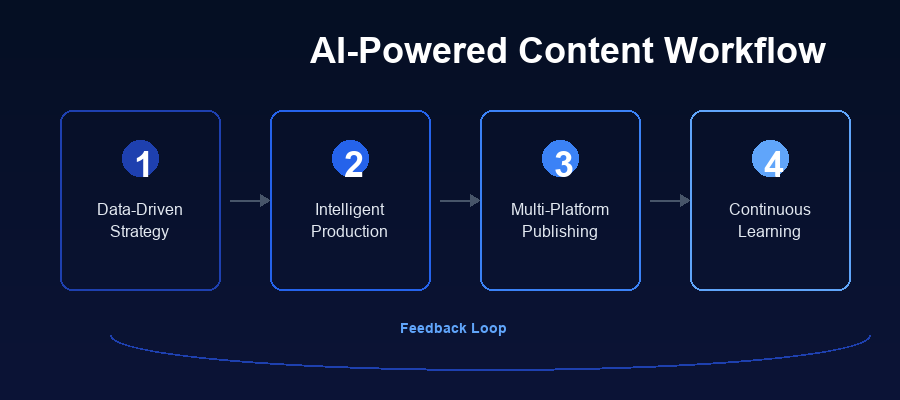
Here’s what the modern AI-assisted content workflow looks like:
1. Data-Driven Strategy
Instead of guessing which topics will resonate, AI analyzes your market landscape — competitor content, audience engagement patterns, trending topics in your niche — and surfaces high-potential content opportunities. The strategy isn’t based on intuition; it’s based on evidence.
2. Intelligent Content Production
AI doesn’t just help you write faster. Modern content systems can transform a single insight into multiple content formats: a long-form article, a video script, social media snippets, and email copy — all maintaining your brand voice and messaging consistency.
3. Multi-Platform Publishing
Each platform has different optimal formats, aspect ratios, caption styles, and posting times. AI handles the adaptation layer, ensuring your content is optimized for LinkedIn, TikTok, YouTube, and your blog without manual reformatting.
4. Continuous Learning
Perhaps most importantly, AI content systems create a feedback loop. Performance data flows back into the strategy engine, identifying winning patterns and automatically adjusting the content mix. This means your content gets measurably better over time.
What This Means for B2B Founders
If you’re running a SaaS company or AI startup, here’s the practical takeaway:
- You don’t need a 10-person content team to maintain a consistent publishing cadence across platforms
- Video is no longer the bottleneck — AI-powered production pipelines can turn text-based insights into professional video content
- Your domain expertise is the moat. AI handles the production mechanics; your unique insights and industry knowledge are what make the content valuable
- Consistency compounds. The companies that publish quality content regularly — not sporadically — are the ones that build organic pipeline
Getting Started: A Practical Framework
You don’t need to overhaul everything at once. Here’s a 3-phase approach:
Phase 1 (Weeks 1-2): Foundation
Define your content pillars — the 3-5 core topics that align with your product value proposition and your audience’s pain points. Set up your AI content tools and establish your brand voice guidelines.
Phase 2 (Weeks 3-6): Execution
Start producing 3-5 pieces of content per week using your AI-powered workflow. Focus on one primary platform first (LinkedIn and TikTok are strong starting points for B2B), then expand.
Phase 3 (Weeks 7+): Optimization
Review performance data. Double down on what’s working. Let the feedback loop refine your strategy. At this stage, you should see a clear correlation between content output and inbound interest.
The Bottom Line
The B2B companies that will win the next decade aren’t the ones with the biggest marketing budgets. They’re the ones that build intelligent content systems — engines that turn expertise into trust, and trust into pipeline.
AI makes this possible for companies of any size. The question isn’t whether to adopt AI-powered content marketing. It’s how quickly you can start.
Ready to see how an AI-powered content engine works in practice? Try Runnax free and experience the difference.